A l’occasion de leur release party Parisienne le 07 juin au Point Ephémère, nous avons eu l’opportunité de rencontrer Les Lullies pour un échange autour de leur nouvel album, Mauvaise Foi, sorti le 26 mai dernier. Fans de bon rock classique, branché punk et garage, si vous avez loupé cette sortie, il est temps de se rattraper !
Interview par Marye Davenne et Victor Brunerie
Effectué le 06 juin 2023 au Dr. FeelGood Paris
English version available below
Marye : A la veille de votre release party, comment vous vous sentez ?
Manah : En forme ! On a eu le temps de se reposer hier.
Romeo : On est quand même en plein milieu de tournée, on est parti depuis plus d’un mois.
Manah : Notre release party tombe en plein milieu de tournée, donc ca fait longtemps que ca a démarré. On est très content de rejouer à Paris
Victor : Votre album est sorti officiellement la semaine dernière, quels sont les premiers retours que vous avez reçu depuis la sortie ?
Manah : Positif ! On a fait plein d’interviews, on a eu plein de retour, même dans les autres pays.
Romeo : On est en tournée, l’album se vends plutôt bien. On a pu le promouvoir en Espagne, sur une radio nationale.
T. Boy : Le retour que l’on a beaucoup, c’est le fait que l’on est passé au Français, on nous en parle beaucoup, mais ca reste positif ! La production n’est pas le même que sur l’album précédent, on nous demande souvent pourquoi on a pris un « virage ».
Romeo : L’album vient juste de sortir donc on n’a pas encore le recul suffisant. On a quelques articles par-ci par-là.
T.Boy : Oui, beaucoup de webzines, de radio, des petits médias et quelques gros.
Victor : En live vous jouez tout l’album, pour le coup, le retour du public, vous l’avez en live…
Romeo : En live, c’est très positif. On avait beaucoup tourné sur nos anciens morceaux sur bien 4-5 ans. On sent que le public est content qu’on revienne avec un nouvel album. Avant, on avait qu’un seul morceau en Français, là on a tout un album. On a sorti deux clips, on a été pas mal diffusé sur les radios, donc les gens connaissent déjà les morceaux.
T. Boy : On a pas mal bossé le live, donc c’est bien béton.
Manah : Et puis ça fait longtemps qu’on travaille ensemble, donc c’est simple.
T. Boy : On a quand même travaillé pas mal les morceaux pour le live.
Manah : On a eu le temps de travailler ce set.
Marye : J’imagine, avec le covid..
Romeo : On avait déjà composé avant le covid, mais ca a permis de se peaufiner.
Manah : Avant la pandémie, on n’avait pas vraiment eu le temps de faire ce travail de détail, car on tournait beaucoup, on n’avait pas vraiment le temps.
Marye : Pour revenir du coup sur l’album en lui-même, on est sur un album quasiment 100% en français, sur un label Américain. Ce n’est pas souvent qu’on a ce genre de « configuration ».
Romeo : On est un groupe Français, mais qui joue beaucoup à l’étranger, même plus à l’étranger qu’en France. On a beaucoup de connexion avec la scène punk underground présent sur ce label Américain, Slovening Records, qui a aussi une branche à Berlin. Vu qu’à la base, on faisait vraiment du punk en anglais. Le label nous a proposé un deal, un premier EP et le premier album. On leur a proposé cette nouvelle formule en Français, et ça leur va carrément. Le responsable du label aime beaucoup les groupes qui changent et qui osent.
T. Boy : On a juste fait gaffe, et j’ai insisté auprès du label pour qu’on travaille avec un distributeur Français. On voulait que le disque en France soit distribué correctement dans notre pays. On a donc travailler avec L’Autre Distribution, qui distribue Lollipop Records et beaucoup de choses.
Marye : En plus, on sent une grosse communauté qui suit beaucoup les sorties de L’Autre Distribution, sur les réseaux, ils sont très actifs.
T. Boy : Pour savoir un peu, j’ai demandé l’avis de beaucoup de disquaires, pour savoir avec qui ils travaillaient, L’autre Distribution, c’est le nom qui est beaucoup revenu. Les gens semblaient contents de leur manière de travailler. C’est aussi ce que je voulais, c’est à dire un distributeur qui défends le truc, et ne fait pas que du catalogage. L’autre, ils savent défendre un album, et le mettre en avant dans leur catalogue.
Roméo : C’était nécessaire, pour un album sur un label Américain, pour garder une belle vitrine, une belle promo chez nous.
T. Boy : Il ne fallait pas que le disque soit totalement inconnu chez nous, du public mais aussi des disquaires. On a déjà vu, pour certains, 90% des disquaires n’ont jamais entendu parler de ton disque, je pense que c’est un problème.
Victor : Et donc, au final, d’où vient l’envie de switcher de langue comme ça ? L’album n’est pas à 100%
T. Boy : La chanson en anglais, c’est une reprise, on ne voulait pas faire un plan à la Johnny Halliday à adapter en Français un titre américain [rire]. On a gardé le morceau dans sa langue d’origine.
Roméo : On est plus à l’aise en Français, les textes ont plus de sens, peut-être car ils sont plus personnels. On chante mieux, avec plus d’aisance.
Manah : Plus intéressant !
T. Boy : Il y a eu un truc d’essai, qui ne l’était pas vraiment à ce moment là, mais sur le premier album, on avait un morceau en Français. On s’est rendu compte que ça nous plaisait, que ca fonctionnait.
Roméo : Puis on en a eu marre de chanter en anglais aussi
T. Boy : Même si on parle tous plus ou moins anglais, faut dire ce qu’il y est, on n’a pas un accent de fou, on a un vocabulaire un peu plus limité
Romeo : Et on chante tout à double voix, en anglais c’est quand même bien moins facile !
T. Boy : Oui, il y a ça aussi, on chante tout à double voix, avec de vraies harmonies.
François : Oui même pour les placements, les intonations de voix, on a plus ou moins les même en double chant. C’est plus facile, ça a plus d’impact.
Marye : L’album a été enregistré à Château Vergogne, comment ca s’est passé ?
Romeo : C’était beaucoup de travail ! Ça s’est bien passé, mais on a dù faire deux sessions. L’ingé son, notre copain Maxime Smadja, est très exigeant. Et il a raison, car l’album est beaucoup plus produit !
T. Boy : Ne cesserai-ce que pour régler à la perfection le son de la batterie, c’est deux jours. On s’y est mis le soir à la monter, toute la journée du lendemain à régler, pour ne commencer les prises qu’après.
Romeo : Guitare, on a tenté plein de combinaisons
François : C’est vrai, on changeait à chaque fois !
Romeo : C’était hyper exigeant, mais ça s’est super bien passer. On a toujours la pression, car tu ne veux pas faire de la merde.
T. Boy : On a fait une prise en fin de journée, de Zero Ambition. On la ré-écoute, et il nous dit « Mais les gars, c’est de la merde cette prise » [rire]
Romeo : Ouais, mais il te dit ça, ça te fout les boules, mais ça nous tire vers le haut. J’ai déjà travaillé avec certain, qui te disent que c’est mauvais, mais qui ne viennent pas derrière te soutenir, te motiver, te donner des astuces.
François : Après il était tard, on ne trouvait pas un son parfait. On a changé 4 fois de réglage de son, 4 fois de guitare.
Romeo : Il nous disait « Les gars, vous pouvez faire mieux que ça, je le sais ! ». Quand t’es fatigué, parfois tu te remets en question, mais ça nous aide.
Victor : Votre musique, c’est un mélange de garage rock, parfois plus énergique, avec un peu de glam.
Romeo : On a toujours voulu faire de la musique, du rock. Pas vraiment du garage rock. Déjà le terme est tellement large. Ca peut partir des Osees à groupes 60’s. Nous on a voulu faire du rock’n’roll, avec des touches de power-pop, et punk, ça va toujours ensemble. Le premier album, ça se définit vraiment comme ça. Ce sont les gens qui nous ont donné une étiquette de garage, ça nous fait rigoler quand on le voit sur les affiches. Les Lullies, garage punk
François : Garage punk’n’roll
T.Boy : Le pire c’est punk’n’roll.
Romeo : On sait que le terme rock’n’roll c’est large.
T. Boy : Souvent chez les anglosaxons, quand tu dis rock’n’roll, ça veut dire rockabilly, années 50. Donc c’est parfois compliqué de définir vraiment le truc.
Victor : Pour pas se retrouver avec un public qui s’attends à quelque chose, ou qui ne va pas adhérer.
T. Boy : Oui, ou d’avoir les gens qui lisent une étiquette en se disant que ce n’est pas pour eux, alors que si ! Une anecdote assez rigolote, c’est Little Bob Story, la première fois qu’ils sont allés jouer en Angleterre, c’était annoncé comme un groupe de rock’n’roll sauf qu’ils ne savaient pas eux que ça voulait dire 50’s. Ils se sont retrouvé face à une horde de teddy boy dans un bar, qui voulait entendre que du Lewis. Eux ils attaquent leur truc à la MC5, et le public faisait la gueule. Il voulait entendre du Little Richard.
Marye : Vous tournez déjà à l’étranger, avec ce deuxième album, vos ambitions sont de continuer à tourner encore plus loin à l’étranger, ou ramener plus de public Français ?
T. Boy : Moi j’aimerai bien faire des trucs qu’on n’a encore jamais fait.
François : C’est bizarre de sortir un album en Français quand on veut partir jouer au Japon. Mais, moi j’aimerai beaucoup aller en Asie, un peu d’Amérique du Sud.
T. Boy : On a pas trop fait le nord de l’Europe. On a fait une fois le Danemark, c’était super cool. On a joué en Allemagne, on aimerait faire la Suède. Normalement, on est censé aller au Mexique en février prochain. On a encore des choses à peaufiner. Un truc qu’on a vraiment pas encore fait, c’est jouer au milieu de la Méditerannée, sur un bateau. C’est une croisière qui va d’Italie en Espagne, un festival sur la mer.
Manah : Il ne faut pas que ce soit trop long, le moins de temps possible sur l’eau [rire]
T. Boy : Il va être avec sa bouée canard toute la traversée
Manah : Oh mais je t’assure que je vais mettre des brassards pour jouer. C’est pas le mal de mer, c’est juste la mer en général. Sérieusement, ça doit être dur de jouer avec des brassards.
Francois : Oh mais ca peut être bien, la route du Rhum, départ de La Rochelle [rire], tournée du cap Horn
Manah : Pourquoi pas traverser l’Atlantique sans vivre, juste notre matos musique aussi !
Romeo : Oula, prochaine question non ? [rire général]
Manah : Comment compter vous traverser l’océan sans vivre, sans eau ? [rire]
T. Boy : On dit tellement de connerie, vous ne savez plus comment relancer ahah
Victor : Oh mais si ! On voulait avoir votre avis sur la scène Française rock. Est-ce qu’il y a de belles pépites qui se cachent dans vos playlists ?
T. Boy : J’ai fait une compil qui s’appelle Nuits Blanches, sorti chez Lollipop Records, label de Marseille. Il y a 16 groupes français dessus, que des groupes actuels.
Manah : Il n’a pas pu mettre tout ce qu’il y a de bon dans la scène Française, mais c’est déjà une belle sélection.
Marye : Ce genre de compil, c’est un beau signe que tu as un bel espoir pour nos artistes ?
T. Boy : C’est là, ça existe, j’y crois. Après les gens en font ce qu’ils veulent.
Manah : Il y a sur cette compil des groupes qui jouent à l’étranger dont nous, mais pas tous! Ca serait cool qu’ils puissent tous avoir la chance de jouer ailleurs, ça serait trop cool car beaucoup méritent énormément.
Francois : L’idée principale c’est aussi de marquer, cette année là, il y avait ces groupes là !
T.Boy : L’idée de base de la compil, c’est inspiré de ce qui se faisait dans les années 80, comme ce que faisait Closer Records avec les compils Eyes on You. Une sorte de Polaroid instantanée de la scène. On peut retrouver Asphalt, un des meilleurs groupes en France, qui vient de Toulouse, qui ne tournent pas beaucoup.
Romeo : FLATHEAD, c’est un très bon groupe, très pop.
Marye : On est sur la scène du Sud de la France là ! Marseille, Montpellier, Nimes.. Nous on vient de Lille
Romeo : A Lille, y’avait les Crusaders Of Love, c’est un groupe fantastique, qui a tourné à l’étranger, aux Etats-Unis. C’est trop la classe.
Marye : Merci beaucoup pour votre temps, ces échanges très intéressants.
Merci beaucoup à Angie, de NRV Promotion pour l’opportunité, et au groupe pour leur sympathie.
A lire également :
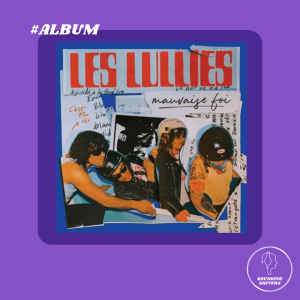
To coincide with their Paris release party at Point Ephémère on 07 June, we met up with Les Lullies for a chat about their new album, Mauvaise Foi, released on 26 May. Fans of classic rock, punk and garage, if you missed this release, it’s time to catch up!
Interview by Marye Davenne and Victor Brunerie
Conducted on 06 June 2023 at Dr. FeelGood Paris
Marye: On the eve of your release party, how are you feeling?
Manah: In great shape! We had time to rest yesterday.
Romeo: We’re still in the middle of our tour, we’ve been away for over a month.
Manah: Our release party is right in the middle of our tour, so it’s been a while since we started. We’re really happy to be playing in Paris again.
Victor: Your album was officially released last week. What initial feedback have you received since its release?
Manah: Positive! We’ve done a lot of interviews and got a lot of feedback, even in other countries.
Romeo: We’re on tour now and the album’s selling really well. We’ve been able to promote it in Spain, on a national radio station.
T. Boy: The feedback we’re getting a lot is that we’ve switched to French, we’re getting a lot of talk about it, but it’s still positive! The production isn’t the same as on the previous album, and we’re often asked why we’ve taken a ‘turn’.
Romeo: The album’s only just come out, so we don’t have enough perspective yet. We’ve got a few articles here and there.
T.Boy: Yes, a lot of webzines, radio, small media and a few big ones.
Victor: You’re playing the whole album live, so the feedback from the public is something you get live…
Romeo: Live, it’s been very positive. We’d been touring a lot with our old songs for a good 4-5 years. We can feel that the public are happy that we’re back with a new album. Before, we only had one song in French, but now we’ve got a whole album. We’ve released two videos, and we’ve had quite a bit of radio airplay, so people already know the songs.
T. Boy: We’ve done a lot of live work, so it’s all pretty solid.
Manah: And we’ve been working together for a long time, so it’s pretty straightforward.
T. Boy: We did work on the songs for the live show.
Manah: We’ve had plenty of time to work on this set.
Marye: I imagine, with the pandemy…
Romeo: We’d already written before the pandemy, but it gave us time to polish things up.
Manah: Before the pandemic, we didn’t really have time to work on the details, because we were touring a lot and didn’t really have time.
Marye: Coming back to the album itself, we’re working on an album that’s almost 100% in French, on an American label. It’s not often that we get this kind of ‘configuration’.
Romeo: We’re a French band, but we play a lot abroad, even more abroad than in France. We’ve got a lot of connections with the underground punk scene on this American label, Slovening Records, which also has a branch in Berlin. Basically, we were doing punk in English. The label offered us a deal, a first EP and the first album. We offered them this new formula in French, and they were totally cool with it. The head of the label really likes bands that change and dare.
T. Boy: We were just careful, and I insisted to the label that we work with a French distributor. We wanted the record to be properly distributed in France. So we worked with L’Autre Distribution, who distribute Lollipop Records and a lot of other stuff.
Marye: What’s more, there’s a big community following L’Autre Distribution’s releases and they’re very active on the networks.
T. Boy: To find out, I asked a lot of record shops who they worked with, and L’Autre Distribution was the name that came up a lot. People seemed happy with the way they worked. That’s also what I wanted, i.e. a distributor who defends the thing, and doesn’t just do cataloguing. L’Autre, they know how to defend an album, and put it forward in their catalogue.
Roméo: It was necessary, for an album on an American label, to keep a nice showcase, a nice promo back home.
T. Boy : We didn’t want the record to be totally unknown in our country, not only to the public but also to record shops. We’ve already seen that 90% of record shops have never heard of your record, and I think that’s a problem.
Victor: So, in the end, where did the desire to switch languages come from? The album isn’t 100%
T. Boy: The song in English is a cover version. We didn’t want to do something like Johnny Halliday and adapt an American song into French [laughs]. We kept the song in its original language.
Roméo: We’re more comfortable in French, the lyrics make more sense, maybe because they’re more personal. We sing better, with more ease.
Manah: More interesting!
T. Boy: There was a trial run, which wasn’t really a trial run at the time, but on the first album we had a song in French. We realised that we liked it, that it worked.
Roméo : Then we got fed up of singing in English too.
T. Boy: Even though we all speak English to a greater or lesser extent, let’s face it, we don’t have a crazy accent and our vocabulary is a bit more limited.
Romeo: And we sing everything in double voices, so it’s not as easy in English!
T. Boy: Yes, there’s that too, we sing everything in double voices, with real harmonies.
François: Yes, even when it comes to placement and vocal intonation, we have more or less the same in double vocals. It’s easier and has more impact.
Marye: The album was recorded at Château Vergogne, how did it go?
Romeo: It was a lot of work! It went well, but we had to do two sessions. The sound engineer, our friend Maxime Smadja, is very demanding. And he’s right, because the album is much more produced!
T. Boy: It took two days just to get the drum sound just right. We set it up in the evening and spent the whole day the next day adjusting it, only to start recording afterwards.
Romeo: Guitar, we tried all kinds of combinations.
François: It’s true, we changed every time!
Romeo: It was really demanding, but it went really well. There’s always pressure, because you don’t want to do shit.
T. Boy: We did a take of Zero Ambition at the end of the day. We listened to it again and he said, « Guys, this take is shit » [laughs].
Romeo: Yeah, but he says that to you, it scares the shit out of you, but it’s a real boost. I’ve already worked with some people who tell you that it’s bad, but don’t come back and support you, motivate you, give you tips.
François : Afterwards, it was late and we couldn’t find a perfect sound. We changed our sound settings 4 times and our guitars 4 times.
Romeo: He used to say to us, « Guys, you can do better than that, I know you can! When you’re tired, sometimes you question yourself, but that helps us.
Victor: Your music is a mixture of garage rock, sometimes more energetic, with a bit of glam.
Romeo: We’ve always wanted to make music, rock music. Not really garage rock. First of all, the term is so broad. It can be anything from Osees to 60s bands. We wanted to make rock’n’roll, with touches of power-pop, and punk, that always goes together. That’s really how we defined our first album. It’s people who have labelled us garage, it makes us laugh when we see it on posters. Les Lullies, garage punk
François: Garage punk’n’roll
T.Boy: The worst is punk’n’roll.
Romeo: We know that rock’n’roll is a broad term.
T. Boy: In the English-speaking world, when you say rock’n’roll, it often means rockabilly, the 50s. So it’s sometimes complicated to really define the thing.
Victor: So you don’t end up with an audience that expects something, or that doesn’t buy it.
T. Boy : Yes, or people reading a label and thinking it’s not for them, when in fact it is! The first time they went to play in England it was advertised as a rock’n’roll band, but they didn’t know that meant 50s. They found themselves in front of a horde of teddy boys in a bar, who only wanted to hear Lewis. They attacked their thing in the MC5 style, and the audience was pissed off. They wanted to hear Little Richard.
Marye: You’re already touring abroad, and with this second album, are your ambitions to continue touring even further abroad, or to bring more French audiences back?
T. Boy: I’d love to do things we’ve never done before.
François: It’s strange to release an album in French when you want to go and play in Japan. But I’d really like to go to Asia and a bit of South America.
T. Boy: We haven’t done too much in Northern Europe. We did Denmark once, which was really cool. We’ve played in Germany and we’d like to do Sweden. Normally, we’re supposed to go to Mexico next February. We’ve still got some fine-tuning to do. One thing we really haven’t done yet is play in the middle of the Mediterranean, on a boat. It’s a cruise from Italy to Spain, a festival on the sea.
Manah : It shouldn’t be too long, as little time as possible on the water [laughs].
T. Boy: He’ll be with his duck buoy the whole way.
Manah: Oh, but I assure you I’ll be wearing armbands when I play. It’s not seasickness, it’s just the sea in general. Seriously, it must be hard to play with armbands on.
Francois : Oh but it could be good, the Route du Rhum, starting from La Rochelle [laughs], rounding Cape Horn
Manah: Why not cross the Atlantic without living, just our music gear too!
Romeo: Oula, next question no? [general laughter].
Manah: How do you expect to cross the ocean without living, without water? [laughs]
T. Boy: People talk so much rubbish, you don’t know how to raise your voice any more ahah
Victor: Oh yes, we do! We wanted to get your opinion on the French rock scene. Are there any hidden gems in your playlists?
T. Boy: I made a compilation called Nuits Blanches, released by Lollipop Records, a label based in Marseilles. There are 16 French groups on it, all of them contemporary.
Manah: They didn’t manage to include everything that’s good on the French scene, but it’s already a good selection.
Marye: Is this kind of compilation a good sign that you have high hopes for our artists?T. Boy: It’s there, it exists, I believe in it. After that, people can do what they want with it.
Manah: There are bands on this compilation who play abroad, including us, but not all of them! It would be really cool if they could all get the chance to play elsewhere, because a lot of them deserve it.
Francois: The main idea is also to mark the fact that that year there were these bands!
T.Boy: The basic idea behind the compilation was inspired by what was done in the 80s, like what Closer Records did with the Eyes on You compilations. A sort of instant Polaroid of the scene. There’s also Asphalt, one of the best bands in France, from Toulouse, who don’t tour much.
Romeo: FLATHEAD, they’re a very good band, very pop.
Marye: We’re on the South of France scene here! Marseille, Montpellier, Nimes. We’re from Lille
Romeo: In Lille, there was the Crusaders Of Love, they’re a fantastic band who’ve toured abroad, in the United States. They’re a real class act.
Marye: Thank you very much for your time and these very interesting discussions.
 Sounding Shivers