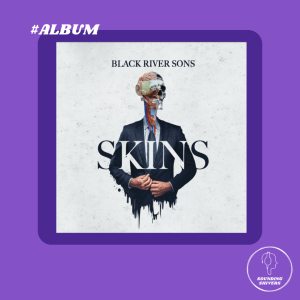
Début octobre sortait Skins, nouvel album des nordistes de Black River Sons. Un bel album aux influences entre southern rock et hard rock. A cette occasion nous avons pu échanger avec Frédéric, bassiste de la formation, sur la création de l’album, les influences du groupe et leurs coups de cœur musicaux.
Propos recueillis par Victor BRUNERIE et Karl DUCHEMIN
English version below
Bonjour! Peux-tu présenter rapidement la formation pour avoir un rapide historique de Black River Sons ?
Black River Sons a été créé par le chanteur du groupe, Emeric Martel en 2016. Une partie des membres du groupe actuel a rejoint le groupe à sa création, dont Vincent à la batterie et d’autres personnes qui ont participé à l’évolution du groupe? J’ai rejoint le groupe en 2019 en tant que bassiste et nous avons accueilli un nouveau guitariste, Guillaume Singer, qui est aussi guitariste de Dead Seasons et Horns, suite au départ de l’ancien.
Votre album est sorti en début de mois. Quel est votre ressenti après 1 mois depuis sa sortie, quel est votre ressenti et avez-vous eu des retours sur votre musique et sur l’album ?
Oui, nous avons eu des retours de la presse et des personnes qui sont venues nous voir en concert et ont pu découvrir les nouveaux morceaux, des personnes qui nous suivent depuis pas mal de temps et ont pu nous donner leur ressenti. Ca correspondait à ce qu’on imaginait, à savoir que la musique est un peu plus brute et agressive que le précédent album, mais globalement on a conservé notre ADN qui est constitué de classic rock, de rock sudiste et de hard rock. Les retours ont été particulièrement bons, cela nous fait très plaisir. Pour l’instant on est en phase où on reçoit les premiers avis et où on voit les ressentis du public et pour l’instant on a que du positif ce qui est encourageant, ce qui n’était pas forcément le cas pour l’album précédent.
Et votre ressenti à vous, pour le moment vous êtes encore sur la sortie récente ?
On est complètement sur la sortie récente. La construction d’un album, c’est quelque chose de très très long, difficile et prenant, on a commencé à écrire l’album il y a pas mal de temps maintenant et on a essayé, cette fois-ci, de faire quelque chose où on pourrait se dire “on a été jusqu’au bout”, on a vraiment fait l’album qu’on voulait faire, et ce ressenti là c’est une fierté. Contrairement au précédent, on a vraiment le sentiment qu’on a pu aller jusqu’au bout de notre proposition, qu’on aurait d’une certaine façon pas pu faire mieux.
Comme tu le disais, votre précédent album était plutôt orienté southern rock, et là vous avez gardé ces influences là mais fait des compositions un peu plus brutes. Est-ce que c’était une volonté d’aller dans ce sens là ou est-ce que c’est quelque chose qui s’est imposé lors de la composition de l’album ?
On a pas mal réfléchi sur nous même au début de la phase d’écriture de l’album, c’était la période du covid, je suis arrivé dans le groupe précisément à cette période là. J’ai pris quelques responsabilités en arrivant dans le groupe : participer à la composition et à l’écriture de tous les textes. On a quand même réfléchi un petit peu à ce qu’on voulait proposer, en cherchant à faire quelque chose de très cohérent, mais aussi de partir du rock sudiste comme base et de l’enrichir avec nos influences diverses, certaines sont plus ressenties et d’autres plus dissimulées. Il y a un jeu d’influences très très large qui ont participé au résultat final, on voulait surtout avoir un album qui sonne plus lourd, plus agressif, et pouvoir explorer une partie plus sombre et énergique de la musique qu’on peut retrouver dans le hard ou dans le métal. C’est ce qu’on a réussi à faire, notamment, avec l’arrivée de Guillaume in extremis avant la fin de la production de l’album, qui a une identité très marquée dans les musiques hard, métal et extrêmes. Il nous a permis de formaliser les ingrédients qu’il nous manquait un peu mais qu’on voulait voir apparaître dans l’album. On voulait que l’album soit assez riche tout en restant cohérent, si tu l’écoute tu verras qu’il y a des couleurs un peu blues texan énergique, et qui vont jusqu’à des riffs très lourds sans aller dans le métal extrême.
Au cours de l’album, vous abordez des sonorités vraiment riches et variées, mais vous avez un résultat très cohérent et une construction assez narrative. Comment vous arrivez à ce résultat là à travers la composition ?
Dans le sens narratif, on essaye de construire la composition avec une vision claire de ce à quoi on veut parvenir, on essaye également d’avoir une richesse dans le discours et d’essayer de surprendre parfois, soit dans le choix de l’esthétique globale du morceau soit dans son contenu. Après bien sûr, les morceaux ont été créés dans des circonstances particulières, avec un état d’esprit un peu plus, parfois mélancolique, parfois un peu révolté. Je pense que ça a énormément joué sur le résultat final. On avait différentes couleurs, différentes fréquences, différentes influences qu’on voulait faire figurer dans l’album : un élément mélodique, un élément agressif… La narration de l’album, c’est également des textes qui ont l’ambition d’aller beaucoup plus loin que les précédents. A la base, l’idée c’est de sortir d’un carcan préétabli parce que l’on pense être le rock sudiste, de ce que les puristes imposent d’être. On s’est séparés véritablement de cette obligation de rentrer dans ces codes là et on s’est autorisés à aller plus loin dans la recherche et la construction des grilles d’accords, des solos, des arrangements… on a tenté d’enrichir le discours.
Vous commencez à avoir une certaine ancienneté en tant que formation sur la scène régionale. Comment voyez vous cette longévité pour le groupe ?
Comme quelque chose qui n’est jamais acquis. Aujourd’hui c’est très très difficile pour un groupe comme nous, qui sommes dans une proposition musicale assez particulière, de pouvoir fédérer, de pouvoir convaincre, parce qu’il a tout de suite un peu la surprise, et je pense que les gens ont besoin de cases pour pouvoir s’identifier, pour pouvoir rentrer dedans. Nous, on a cette particularité là, avec une expérience qui est relativement faible – on a 6/7 ans d’existence – même si on a déjà fait 2 albums et un EP. On essaye de gagner à chaque concert de l’attention, de l’adhésion, et c’est vraiment un combat. On est un groupe de composition, pas simple pour un groupe de composition d’exister, on est dans un océan de groupes de covers, dans un registre rock qui n’est pas surreprésenté à la radio, donc c’est doublement, triplement compliqué. Mais petit à petit, je dirais que notre fan base, elle est solide et fidèle.
Dans les textes qu’on a pu lire sur le groupe, des influences comme Audioslave ou Black Stone Cherry sont citées. Est-ce que tu citerais des influences à titre personnel et comment elles t’ont fait évoluer en tant que musicien ?
Les influences que nous avons sont d’abord communes. Ce que l’on joue ensemble, ce n’est pas un hasard. On a cette espèce de terrain commun à 4, avec des goûts relativement proches : le classic rock, le hard rock, le rock sudiste sous toutes ses formes. On a été très influencés par Lynyrd Skynyrd, Molly Hatchet, The Allman Brothers… ce genre de creuset musical là nous a beaucoup marqué. Chacun apporte ses influences qui peuvent être très très diversifiées. Dans la composition, de manière implicite, ou explicite, on a tous amené quelque chose qui pouvait provenir d’influences musicales assez étonnantes et éloignées de ce qu’on propose. On prend ça comme une manière d’enrichir, on ne s’interdit rien. C’est une proposition musicale qui vient un peu des tripes. On estime qu’à notre époque, dans l’optique de ce style, il nous est permis d’essayer de rendre cohérents des concepts et des approches qui viennent d’autres musiques. Par exemple, il y a des éléments dans l’album qui pourrait provenir de Stevie Ray Vaughan, ou bien encore, je ne dirais pas sur quel morceau, il y a une influence de Dream Theater. Ça peut paraître inattendu, pas forcément dans la mélodie ou dans la construction, ça peut être bien plus insinué que ça. Ce n’est pas forcément quelque chose de recherché. On s’efforce dans la création, la composition et l’écriture, d’écouter ce que dit notre tête et notre ressenti et nos émotions personnelles pour les traduire en sons, en morceaux, en disque. C’est un processus un peu étrange mais je pense que c’est la clé pour atteindre des horizons inattendus.
Avec le groupe, vous avez pu faire de nombreuses scènes avec des noms qui sont assez importants, par exemple The New Roses, Laura Cox ou D-A-D. Qu’est ce que vous retenez de ces expériences là et si il y avait un groupe avec lequel vous voudriez jouer absolument, ça serait lequel ?
On retient toujours l’expérience de voir des musiciens bien plus connus et expérimentés que nous. Les observer, les côtoyer, c’est toujours une énorme chance. Au-delà de l’expérience de pouvoir les approcher et partager la scène avec eux, l’observation nous permet de voir ce qui nous sépare d’eux. Parfois, le diable réside dans les détails, et cette somme de détails nous permet nous aussi de nous nourrir, de progresser, et parfois en discutant avec eux, de constater leur parcours, par quelles galères ils sont passés pour en arriver là. C’est toujours gratifiant de pouvoir vivre des expériences comme celles-ci, et surtout de pouvoir jouer devant leur public quand on fait une première partie. Ça nous permet une belle exposition. Ensuite, pour les gens avec lesquels on aimerait jouer, la réponse pourrait être différente pour chacun des musiciens. On assume tout à fait d’être des personnalités différentes, y compris au niveau de nos influences. A titre personnel, si je pouvais faire la première partie d’un groupe, dans mes rêves les plus fous, je dirais Extreme, Thunder. Il y a plein de musiciens avec lesquels ça serait une expérience fantastique de partager une journée.
Pour terminer, quels groupes t’ ont fait vibrer dans la scène française cette dernière année ?
On a eu l’occasion il y a à peu près une semaine de jouer avec un groupe qui était absolument extraordinaire, Red Beans and Pepper Sauce, des musiciens qui viennent de Montpellier. Des gens à la fois adorables et des musiciens extraordinaires qui nous ont proposé un spectacle d’une cohérence et d’un dynamisme qui était assez fou. On a la possibilité de jouer parfois avec des groupes qui sont des véritables découvertes, c’est quelque chose de très inspirant.
Un grand merci à toi pour toutes tes réponses, et à très bientôt en live!
Merci à toi !
Skins, the new album from northerners Black River Sons, was released at the beginning of October. It’s a fine album with influences ranging from southern rock to hard rock. We caught up with Frédéric, the band’s bassist, to talk about the making of the album, the band’s influences and their musical favourites.
Interview by Victor BRUNERIE et Karl DUCHEMIN
Hello! Can you give us a quick introduction to the band and give us a brief history of Black River Sons?
Black River Sons was created by the band’s singer, Emeric Martel in 2016. Some of the members of the current line-up joined the band when it was first formed, including Vincent on drums and other people who have been involved in the band’s development? I joined the band in 2019 as bassist and we welcomed a new guitarist, Guillaume Singer, who is also guitarist for Dead Seasons and Horns, following the departure of our previous guitarist.
Your album was released at the beginning of the month. How do you feel about it now that it’s been out for a month, and have you had any feedback on your music and the album?
Yes, we’ve had some feedback from the press and from people who came to see us live and were able to discover the new tracks, people who’ve been following us for quite a while and were able to give us their impressions. The music is a bit more raw and aggressive than the previous album, but overall we’ve kept our DNA, which is made up of classic rock, southern rock and hard rock. The feedback has been particularly good, and we’re delighted with that. Right now we’re at the stage where we’re getting the first reviews and seeing how the public feels about it, and so far we’ve had nothing but positive feedback, which is encouraging, which wasn’t necessarily the case for the previous album.
How do you feel about the recent release at the moment?
We’re completely focused on the recent release. We started writing the album quite a while ago now and this time we tried to do something where we could say « we’ve gone all the way », we’ve really made the album we wanted to make, and that feeling is something to be proud of. Unlike the previous album, we really feel that we’ve been able to go all the way with what we wanted to do, and that in some ways we couldn’t have done any better.
As you said, your previous album was more southern rock oriented, and here you’ve kept those influences but made your compositions a bit more raw. Was it a conscious decision to go in that direction or was it something that imposed itself during the composition of the album?
We did a lot of thinking about ourselves at the beginning of the writing phase of the album, it was the covid period, I joined the band at precisely that time. I took on a bit of responsibility when I joined the group, participating in the composition and writing of all the lyrics. We thought a bit about what we wanted to offer, trying to make something very coherent, but also starting from southern rock as a base and enriching it with our various influences, some more obvious and others more hidden. There’s a very, very wide range of influences that played a part in the final result, but above all we wanted an album that sounded heavier, more aggressive, and to be able to explore a darker, more energetic side of the music that can be found in hard rock or metal. That’s what we managed to do, in particular, with the arrival of Guillaume at the last minute before the end of the album’s production, who has a very marked identity in hard, metal and extreme music. It allowed us to formalise the ingredients that we were lacking a little but that we wanted to see appear on the album. If you listen to the album, you’ll see that it’s got a bit of energetic Texan blues in it, with some very heavy riffs without going into extreme metal.
Throughout the album, you explore some really rich and varied sounds, but you end up with a very coherent result and a fairly narrative construction. How do you achieve this through composition?
In the narrative sense, we try to build the composition with a clear vision of what we want to achieve, we also try to have a richness in the discourse and try to surprise sometimes, either in the choice of the overall aesthetic of the track or in its content. After that, of course, the tracks were created in particular circumstances, with a slightly different state of mind, sometimes melancholy, sometimes a bit rebellious. I think that played a huge part in the final result. We had different colours, different frequencies, different influences that we wanted to include in the album: a melodic element, an aggressive element… The album’s narrative also includes lyrics that aim to go much further than the previous ones. Basically, the idea was to break away from a pre-established straitjacket, because we think we’re Southern rock, from what the purists dictate we should be. We’ve really broken away from this obligation to fit into these codes and we’ve allowed ourselves to go further in the research and construction of the chord grids, the solos, the arrangements… we’ve tried to enrich the discourse.
You’re beginning to have a certain seniority as a band on the regional scene. How do you see this longevity for the group?
As something that can never be taken for granted. These days it’s very, very difficult for a band like us, who have a very particular musical approach, to be able to unite people, to convince them, because it’s all a bit of a surprise, and I think people need to be able to identify with something, to be able to get into it. That’s a particularity of ours, with relatively little experience – we’ve been around for 6/7 years – even though we’ve already made 2 albums and an EP. We try to gain attention and support at every concert, and that’s a real struggle. We’re in a sea of cover bands, in a rock genre that’s not over-represented on the radio, so it’s doubly, triply complicated. But little by little, I’d say our fan base is solid and loyal.
As you said, your previous album was more southern rock oriented, and here you’ve kept those influences but made your compositions a bit more raw. Was it a conscious decision to go in that direction or was it something that imposed itself during the composition of the album?
We did a lot of self-reflection at the beginning of the writing phase of the album, which was the covid period, and I joined the group at precisely that time. I took on a bit of responsibility when I joined the group, participating in the composition and writing of all the lyrics. We thought a bit about what we wanted to offer, trying to make something very coherent, but also starting from southern rock as a base and enriching it with our various influences, some more obvious and others more hidden. There’s a very, very wide range of influences that went into the final result, but above all we wanted an album that sounded heavier, more aggressive, and to be able to explore a darker, more energetic side of the music that you might find in hard rock or metal. That’s what we managed to do, in particular, with the arrival of Guillaume at the last minute before the end of the album’s production, who has a very marked identity in hard, metal and extreme music. He enabled us to formalise the ingredients that we were somewhat lacking but that we wanted to see on the album. We wanted the album to be quite rich while remaining coherent, so if you listen to it you’ll see that there are some energetic Texan blues colours, and some very heavy riffs without going into extreme metal.
In the texts we’ve read about the band, influences such as Audioslave and Black Stone Cherry are mentioned. Would you mention any influences on a personal level and how they’ve helped you develop as a musician?
The influences we share are first and foremost common. It’s no coincidence that we play together. The 4 of us have this kind of common ground, with relatively similar tastes: classic rock, hard rock, southern rock in all its forms. We were very influenced by Lynyrd Skynyrd, Molly Hatchet, The Allman Brothers… that kind of musical melting pot had a big impact on us. Everyone brings their own influences, which can be very, very diverse. In the composition, implicitly or explicitly, we’ve all brought something that could come from musical influences that are quite surprising and far removed from what we’re proposing. We see it as a way of enriching our work, we don’t hold back on anything. It’s a musical proposition that comes from the gut. We feel that in this day and age, with this style in mind, we’re allowed to try and make coherent concepts and approaches that come from other music. For example, there are elements on the album that could come from Stevie Ray Vaughan, or, I wouldn’t say on which track, there’s an influence from Dream Theater. It may seem unexpected, not necessarily in the melody or in the construction, it may be much more insinuated than that. It’s not necessarily something we’re looking for. In the process of creating, composing and writing, we try to listen to what our head is saying and to our personal feelings and emotions, and translate them into sounds, into pieces, into a record. It’s a rather strange process, but I think it’s the key to reaching unexpected horizons.
With the band, you’ve played a lot of gigs with some pretty big names, like The New Roses, Laura Cox and D-A-D, for example. What do you take away from these experiences, and if there was one band you’d definitely want to play with, who would it be?
The experience of seeing musicians who are much better known and experienced than you is always something to remember. Watching them, rubbing shoulders with them, is always an enormous opportunity. Beyond the experience of being able to approach them and share the stage with them, observation allows us to see what separates us from them. Sometimes, the devil is in the detail, and this sum of details also allows us to feed ourselves, to progress, and sometimes, by talking to them, to see their journey, what they went through to get there. It’s always gratifying to be able to have experiences like these, and especially to be able to play in front of an audience when you open for them. It gives us great exposure. As for the people we’d like to play with, the answer could be different for each of the musicians. We’re perfectly happy to be different personalities, including in terms of our influences. On a personal note, if I could open for a band, in my wildest dreams I’d say Extreme, Thunder. There are loads of musicians out there with whom it would be a fantastic experience to share a day.
Finally, what bands have thrilled you on the French scene over the past year?
About a week ago, we had the opportunity to play with an absolutely extraordinary band, Red Beans and Pepper Sauce, from Montpellier. They’re lovely people and extraordinary musicians who put on a show that was so coherent and dynamic it was crazy. We sometimes get the chance to play with bands that are real discoveries, and that’s something very inspiring.
Thnaks a lot for all your answers and we hope to see you soon!
Thank you !
A lire aussi / Also to be read:
 Sounding Shivers