Treize ans après leur dernier album, Karnivool revient avec un disque, In Verses, façonné sur une longue période, entre doutes, espoir et persévérance. Dans cet entretien, Ian, chanteur du groupe, raconte l’impact du Covid sur le groupe, la difficulté de reprendre la route après avoir perdu tout l’élan accumulé, et le plaisir presque viscéral de remonter sur scène, que ce soit dans des salles mythiques comme le Bataclan ou dans des clubs intimes, moites et survoltés. Il revient aussi sur la création du nouvel album : un puzzle construit au fil des années, mêlant vieilles idées exhumées, nouvelles inspirations et exigence sonore
par Victor Brunerie
Crédit photo : Tobias Sutter
English version below
Victor : Je voudrais commencer par dire que le nouvel album est absolument génial ! J’étais impatient de l’écouter.
Ian : Merci ! Merci mec, j’apprécie ! Pour être honnête, on est très satisfaits. Et ça nous semble encore très nouveau. Nous avons beaucoup travaillé sur cet album. Et une grande partie a été réalisée à la dernière minute, même si nous y avons travaillé par petites touches pendant des années. Il nous semble donc très nouveau. Et oui, ça fait du bien.
Victor : Je voudrais commencer par parler de votre retour sur scène. Vous deviez partir en grande tournée en Europe pendant la pandémie de COVID, mais celle-ci a été reportée. Comment s’est passé ce retour sur scène pour vous et pour le groupe ?
Ian : Oui, c’était tellement bon de revenir, de pouvoir remonter sur scène. C’est un endroit merveilleux. C’est là que nous aimons être. C’est notre espace de bonheur. C’était intéressant, cette période où nous avions prévu de partir en tournée, et où le COVID et la période post-COVID ont tout foutu en l’air. C’était un mauvais moment, parce que nous avions beaucoup d’élan en tant que groupe à l’époque. Nous étions super excités par ce que nous écrivions, et tout coulait de source à ce moment-là. Évidemment, au fil des ans, nous avons connu des hauts et des bas dans notre inspiration et notre travail, mais à l’époque, tout allait vraiment bien. Et oui, ne pas pouvoir faire ça alors que nous étions prêts nous a un peu coupé l’herbe sous le pied. Ça semble être un lointain souvenir maintenant, mais à l’époque, ça a été difficile pour nous. Pour être honnête, il nous a fallu un certain temps pour nous en remettre.
Victor : J’étais à un concert à Paris avec The Ocean. C’était génial !
Ian : Oh, mec, c’était un super concert ! C’était au Bataclan ! Quelle salle incroyable ! On adorerait y retourner, c’était un concert dingue.
Victor : Et j’étais aussi au concert au Black Lab près de Lille.
Ian : Oh, sans blague ?!
Victor : Oui, c’était aussi un concert incroyable !
Ian : C’était un concert génial à Lille. C’est le genre de salle assez petite où les gens sont tout près de la scène. Il n’y a ni scène ni barrière de sécurité, on est juste devant eux. Il faisait super chaud. On transpirait. C’était sale. C’était du rock and roll. Je m’en souviens. C’était l’un de mes concerts préférés de cette dernière tournée. Cette semaine-là, c’était le sixième concert d’affilée. Donc ça faisait un, deux, trois, quatre, cinq, six concerts d’affilée. Et je me souviens qu’on se disait tous : « Oh mon Dieu, c’est le sixième concert. On est tous un peu cuits. » Et puis le concert a commencé, il faisait chaud ce soir-là et il y avait des gens vraiment sympas dans le public. Et oui, on s’est éclatés. C’était génial.
Victor : Lors de ces derniers concerts en Europe, vous avez joué quelques morceaux du nouvel album. Qu’avez-vous pensé de jouer ces morceaux pendant cette tournée, de commencer à jouer de nouveaux morceaux pour les fans ?
Ian : Oh, eh bien, je pense que nous sommes très conscients que nos fans sont impatients d’entendre, vous savez, les nouveautés du groupe. Alors nous avons pris le temps de faire des essais, en quelque sorte, avec des morceaux comme « Aozora » et je ne me souviens même pas si nous avons joué « Ghost ». Peut-être que oui. Je ne m’en souviens pas. Mais au moins, nous avons essayé une ou deux nouveautés. Tu sais, quand tu arrives à ce stade où tu es suffisamment confiant pour le faire. Et parfois, on n’est pas assez confiants et il faut juste se dire « tant pis ». Il faut juste ressentir ces choses, les jouer dans une pièce et voir la réaction du public. Je pense que c’est super important. Donc oui, c’était bien. Et puis c’était génial de ramener ça au studio et de continuer à travailler.
Victor : C’est votre premier album en treize ans. Tu as dit que vous y avais travaillé par petites touches. Comment vis-tu le fait de travailler sur un album pendant une période aussi longue dans un monde qui change en quelques secondes ? Quel impact cela a-t-il sur les chansons que tu répètes pendant toutes ces années ?
Ian : Je suppose que cela a eu un impact. Je ne conseillerais à personne de mettre 13 ans pour écrire un album. Ce n’est pas conseillé. Je ne le ferais pas. Ce n’est bon pour la santé mentale de personne, mais d’une certaine manière, nous sommes très doués pour ne pas laisser quoi que ce soit ici interférer avec ce que nous essayons de faire. Nous avons donc continué à faire ce que nous faisons, en essayant de le faire du mieux possible et de la seule manière que nous connaissons, et c’est notre processus. C’est une question intéressante, car vous avez raison, l’industrie et tout le reste, tout change de jour en jour, mec. Nous n’y avons pas vraiment réfléchi. Pour être honnête, nous trouvions déjà assez difficile d’écrire la musique. Donc, oui, nous nous fichions complètement de ce qui se passait et nous avons simplement continué à travailler dur, comme on dit.
Victor : Vous avez dit que vous réutilisiez des idées, comme dans « Opal », où vous avez utilisé des idées que vous aviez depuis des années. Comment est-ce de revisiter de vieilles idées lorsque vous écrivez un nouvel album ?
Ian : C’est assez intéressant. C’est comme ouvrir une boîte à jouets que vous avez trouvée dans votre chambre quand vous étiez enfant. On se dit : « Oh, wow, qu’est-ce qu’il y a là-dedans déjà ? » C’est comme : « Oh, oui, il y a un très bon riff dans cette boîte. Ouvrons-la. » Ou peut-être que quelqu’un a gardé les clés pendant longtemps. Dans ce cas, c’est comme si Jon avait toujours gardé les clés d’une boîte qui contenait ce riff particulier pour « Opal ». Il l’avait toujours en tête. Je pense qu’il l’a signalé à Drew alors que la chanson était en phase finale d’écriture. Si je me souviens bien, on l’appelait le riff Smegma, un surnom affectueux qui datait d’il y a dix ans, peut-être plus, je ne sais plus trop. C’est assez fou que des choses puissent rester en suspens aussi longtemps. Et plus j’écoute d’autres musiciens, plus je lis des interviews et plus je découvre les processus créatifs de différentes personnes, plus je me rends compte que ce n’est pas si rare. Ce n’est pas si rare pour les personnes qui travaillent sur des projets assez longs. Elles ont ces choses qui semblent rester dans un coin ou se présenter d’elles-mêmes dans les dernières étapes de la réalisation d’un projet. Et elles se disent : « Oh, en fait, j’étais là depuis le début, et ça va vraiment marcher. » Je trouve ça assez fascinant.
Victor : Que penses-tu du son du nouvel album et de son évolution par rapport au précédent ?
Ian : C’est une bonne question. Je trouve qu’il est très novateur. J’adore le son et l’ambiance de cet album. Je pense que nous avons obtenu ce que nous voulions. Je pense que cela montre vraiment, encore une fois, ce qu’est et ce que peut être Karnivool en tant que groupe et en tant que paysage sonore. Je veux dire, il y a beaucoup de détails dans les parties, et il y a beaucoup de détails dans la conception sonore à travers les parties, l’instrumentation. C’est assez fou. Et j’adore vraiment ce que Forrester (le producteur, ndlr) a fait. Avec son ingénierie et son mixage, je pense qu’il y a toujours eu une histoire entre Forrester et nous. Et ce point de rencontre, ce mariage, a toujours été une bonne chose. Donc oui, je suis très reconnaissant que nous ayons retrouvé notre espace. Et oui, ça fait du bien, mec.
Victor : Quelles sont les idées principales derrière les paroles du nouvel album ?
Ian : Eh bien, fidèles à l’esprit Karnivool, nous aimons garder les choses assez obscures et ne pas trop en dévoiler. Mais je ne sais pas, je suppose que c’est une sorte de petit aperçu de nous-mêmes, de ce que nous avons mis dans cet album et probablement de l’effet émotionnel que cela a eu sur beaucoup d’entre nous, même si je ne m’en rends compte qu’en écoutant les paroles. Cet album reflète beaucoup nos luttes et nos questionnements, comment diable allons-nous y arriver et ce qu’il faudra pour y parvenir. Et puis, oui, ce genre de choses, beaucoup d’espoir. Et l’espoir étant à la fois utile et complètement inutile. Et parfois, il faut juste passer outre l’espoir et foncer, persévérer dans la poursuite de ce que l’on aime. Donc oui, je ne sais pas. Et puis il y a d’autres trucs sympas qui sonnent bien et qui ne veulent pas dire grand-chose, pour être honnête.
Victor : Comment avez-vous choisi la pochette de l’album ?
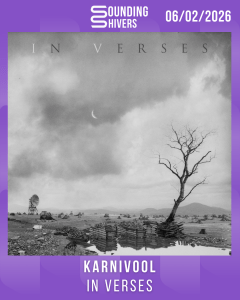
Ian : Oui, je pense que pour la pochette, nous voulions quelque chose qui évoque un paysage. Nous avions cette idée artistique en tête depuis un certain temps déjà. Et nous avions en quelque sorte finalisé ce concept pour un album lorsque nous avons sorti « All it takes ». Le travail que nous avons fait là-dessus est resté en suspens pendant un certain temps. Donc, tout ce paysage, un peu désolé, oui, les conséquences de ce qui s’est passé là-bas reflètent peut-être ce qu’il a fallu pour donner vie à l’album. Et puis, il y a cette petite touche de vie dans l’arbre. Il y a quelque chose de nouveau, un commencement, même si ça a l’air un peu abîmé. C’est là que tu te sens abîmé. Mais oui, ce petit, tu sais, cette renaissance au milieu de la désolation. Et il y a d’autres trucs bizarres là-dedans. Il y a un vieil avion cassé, un OVNI bizarre et d’autres trucs bizarres. Mais j’aime le noir et blanc. J’aime son aspect. Ça fait du bien.
Victor : Ça fait vraiment du bien de voir ça et d’écouter la musique qui va avec. C’est vraiment sympa. Je voulais te demander, certaines chansons sont déjà sorties depuis un certain temps. Comment penses-tu que les fans ont accueilli les nouvelles chansons ?
Ian : Je pense que ça fait du bien. Tout ce que je peux te dire, c’est que ce qu’on ressent lors de nos concerts, quand on partage l’espace avec les fans dans la salle, c’est que « Drone » passe très bien parce que c’est super fun à jouer. C’est une chanson vraiment géniale à jouer. Le groupe peut vraiment s’y investir. Et « Aozora » est vraiment géniale. C’est fou comme on peut montrer une chanson une ou deux fois à quelqu’un et qu’il la connaisse déjà et la chante avec nous, ou qu’il connaisse le refrain ou autre. J’adore nos fans. Ils chantent fort et avec sincérité, c’est génial. Oui, je ne pense pas qu’aucun d’entre nous ne lise vraiment beaucoup de commentaires sur quoi que ce soit. Je ne pense pas que cela ait vraiment d’importance. Ce n’est pas le cas. Je suppose donc que tout est positif. C’est de l’amour. Je pense que finalement, c’est très satisfaisant au fond de nous-mêmes de pouvoir enfin offrir quelque chose dont nous sommes très fiers à ceux qui nous ont accompagnés dans cette aventure. Tu sais, il y a beaucoup de gens qui sont de vrais fans de ce groupe, et ils ont attendu. Et enfin, nous avons quelque chose à dire, à offrir et à partager. Tu sais, ça fait du bien.
Victor : J’allais te demander ce que vous pensez, en tant que groupe et en tant que personnes, de la loyauté de vos fans. Vous n’avez pas sorti de nouvel album pendant 13 ans.
Ian : Je trouve ça incroyable. Ce sont vraiment des fans qui nous soutiennent. C’est sûr et certain. Ce sont des gens incroyables. Ils comprennent parfaitement ce que sont la patience et la frustration, j’en suis sûr. Mais je trouve que toute cette relation est dingue. C’est assez génial. Et ils ont accepté d’attendre que nous trouvions ce que nous voulions exprimer dans cet album. Je ne sais pas, peut-être qu’il faudrait faire une étude sur ces gens. Comment ont-ils pu attendre si longtemps sans sombrer dans l’anarchie totale ? Sans mettre le feu à tout, par exemple. Je ne sais pas. Peut-être qu’ils l’ont fait. Peut-être. Je ne sais pas.
Victor : Vous avez prévu une tournée en Europe en 2026. Que pensez-vous de retourner en Europe dans les prochains mois ?
Ian : J’ai hâte, mec. Chaque fois qu’on va en Europe, c’est différent. Les concerts et les gens là-bas sont vraiment passionnés, et passer d’une ville à l’autre, d’un pays à l’autre, c’est dingue. Tu sais, en Australie, on peut faire une tournée dans tout le pays en deux semaines environ. On peut faire toutes les capitales en une semaine si on s’y met à fond. Donc le fait qu’on puisse aller là-bas et vraiment parcourir tout le pays, c’est génial, mec. Et il y a des fans incroyables là-bas, des fans de musique en général. C’est génial. Donc oui, on reviendra. On y sera de mi-avril à mi-mai l’année prochaine. On a déjà tout organisé. Ce seront principalement des concerts dans des clubs. Et puis on reviendra en 2027, je dirais. Ce sera principalement pour des festivals. Et oui, le train continue de rouler, d’une manière ou d’une autre, tu vois.
Victor : Que penses-tu des nouveaux et des anciens groupes qui font partie de la scène prog aujourd’hui, et comment tout cela fonctionne-t-il avec la nouvelle façon dont les gens écoutent la musique, comme les chansons courtes, les nouvelles chansons toutes les deux semaines, etc. Comment penses-tu que la scène prog s’en sort avec ça ?
Ian : Je pense que c’est un test pour tous ceux qui sont dans ce cas. Si vous avez déjà ressenti le besoin de suivre le rythme, c’est une tâche énorme et un véritable test. Je ne sais pas. Je trouve que c’est une question amusante, car comment peut-on suivre le rythme ? C’est cool si vous y arrivez. Mais il y a aussi tellement de bonne musique qui sort. Et de la même manière, il y a aussi des trucs discutables qui sortent. Je ne sais pas. Ça a toujours été soit les trucs vraiment bons qui se démarquent, soit ceux qui montent au sommet, soit les trucs vraiment bons qui attirent plus l’attention et se frayent leur propre chemin. Et je pense que c’est un peu ce que font les groupes de rock progressif. Je veux dire, c’est essentiellement le côté progressif. Je pense que le progressif, c’est vraiment trouver des façons différentes de faire les choses ou de dire les choses, ou quoi que ce soit d’autre. Donc je ne sais pas. Et pour être tout à fait honnête, je ne suis pas très au courant de qui est où dans la scène prog. Ce que j’aime, c’est que chaque fois que quelqu’un me montre quelque chose, je suis toujours époustouflé et c’est toujours nouveau. Je n’ai aucune idée de ce qui se passe. Alors ne me posez pas de questions sur les groupes, parce que je n’en sais rien. Les autres gars, comme Drew, connaissent tout un tas de groupes dont je n’ai même jamais entendu parler. Oui. Je vous reviendrai là-dessus.
Victor : Je voulais te demander quelle musique tu as particulièrement aimée ces derniers mois ? Quels groupes ou artistes t’ont fait dire : « OK, c’est génial » ?
Ian : Il y a un groupe que nous venons d’emmener en tournée, Big Noter. C’est un groupe australien. Ils viennent de Melbourne. Ils jouent un rock assez politique, un peu dans le style de Rage Against the Machine. C’est assez percutant. Je ne vois rien d’autre pour le moment.
Victor : Merci beaucoup !
Ian : Salut, Victor. Merci. Merci pour ton temps, mec. C’était cool.
Thirteen years after their last album, Karnivool returns with a record, In Verses, crafted over a long period of time, between doubts, hope, and perseverance. In this interview, Ian, the band’s singer, talks about the impact of Covid on the band, the difficulty of getting back on the road after losing all the momentum they had built up, and the almost visceral pleasure of returning to the stage, whether in legendary venues like the Bataclan or in intimate, sweaty, and electric clubs. He also discusses the creation of the new album: a puzzle pieced together over the years, combining old ideas, new inspirations, and high standards for sound.
Photo by Tobias Sutter
Victor : I wanted to start by saying that the new album is absolutely amazing! I Couldn’t wait to listen to it.
Ian : Thank you! Thanks, man, I appreciate that! To be honest, it’s feeling very good to us. And it’s still feeling so very new. There’s a lot that we did on that record. And a lot of it sort of came in the 11th hour, even though we’ve been working on it in bits and pieces for years. So it feels very new to us. And yeah, man, it’s feeling good.
Victor : I wanted to start by talking about you coming back on stage. You were supposed to go on stage for a big tour in Europe during the COVID era, but it got postponed. How was it to come back on stage after that for you and for the band?
Ian : Yeah, it was so good to get back, to be able to get back on stage. It’s a wonderful space. It’s where we like to be. It’s our kind of happy space. It was interesting that period wherewe had planned to tour, and the sort of COVID and post-COVID hangover kind of fucked all that up. And it was a bad time, because we had so much momentum as a band at the time. We were super excited about what we were writing, and it was flowing at the time. Obviously, over the years, we have our ups and downs with our flow and our workflow, but at the time then, it was going really well. And yeah, to not be able to do that when we were kind of ready, kind of knocked the wind out of our sails. It feels like a bit of a distant memory now, but at the time it was like hard for us. It took us a while to sort of recover from that, to be honest.
Victor : I was at a Paris show with The Ocean. That was amazing!
Ian : Oh, man, that was such a good show! That was at Bataclan! What an awesome venue! We would love to get back there, that was a sick gig.
Victor : And I was also at the show at The Black Lab near Lille.
Ian : Oh, no way?!
Victor : Yeah, it was also an amazing show!
Ian : That was a cool show in Lille. It’s like the kind of small enough room and the people are like right up the front. There’s no stage or crowd barrier, like you’re right in their face. It was super hot. It was sweaty. It was dirty. It was rock and roll. I remember that. That was one of my favorite shows of that last tour. That week of that tour, that was like, the sixth show in a row. So it was like one, two, three, four, five, six shows in a row. And I remember we were all like : « Oh God, man, this is like the sixth show. We’re all a bit like cooked » And then the show just came around and that night it was hot and there were some really cool people there. And yeah, we had a sick time. That was good.
Victor : During those last shows in Europe, you played some tracks from the new album. How did you feel about playing those tracks during that tour, like starting to play new material for the fans?
Ian : Oh, well, I think we’re very aware that our fans are eager to hear, you know, the new things that the band’s doing. So we took moments there to kind of rode test, I guess, in a way, some things like « Aozora » and I can’t even remember if we played « Ghost ». Maybe we did. I can’t remember. But at least try one or two new things. You know, when you get to that point where you’re confident enough to do it. And sometimes we’re not confident enough and you’ve just got to say, fuck it. Like, you just got to, you know, feel these things and play them in a room and feel the reaction to things. I reckon that stuff’s super important. So yeah, it was good. And then it was great to take that back and get into a studio and keep working.
Victor : It’s your first album in thirteen years. You said you worked on it inbits and pieces. How is it for you to work on an album for that long period of time in a world that is like changing in seconds? How does it impact the songs that you’re rehearsing during all those years?
Ian : I guess somehow. I mean, I wouldn’t advise anyone to take 13 years to write a record. It’s not advisable. I wouldn’t do that. It’s not good for anyone’s mental health, but it somehow we’re very good at not really letting anything out here really interfere with what we’re trying to do. So we just kept doing what we do and trying to do it the best way we could and do it the only way we know how, and that’s our process. So it’s an interesting question because you’re right, the industry and the whole, everything’s changing like day to day, man. We just didn’t really think about it too much. We just found it hard enough just trying to write the music, to be honest. So, yeah, we just didn’t really give a shit what was happening and just, yeah, head down bum up, as they say.
Victor : You told that you reused ideas ,like in « Opal », you used ideas that you had for years. How is it to revisit old ideas while writing a new album?
Ian : It’s pretty interesting. It’s like opening a toy box you found in your bedroom as an older person. You’re like, oh, wow, what’s in here again? It’s like, oh, yeah, there’s a really good riff in this box. Let’s open that up. Or maybe someone’s held the keys for a long time. In that case, like Jon was always holding the keys to a box that had that particular riff for « Opal » in it. He always had in the back of his mind. I think he brought it to Drew‘s attention as the song was coming together in its later stages. It was called a Smegma riff, if I remember, which was it’s affectionate title from, I don’t know, 10 years ago, maybe longer, I’m not sure. So it’s pretty wild that things can hang around that long. And the more I listen to other musicians and read interviews and different people’s processes. It’s not that uncommon for people who work on pretty long-form projects. They have these things that just seem to hang around or seem to present themselves in the last stages of completing something. And they’re like, oh, actually, I’ve been here the whole time, and that’s really going to work. I find that stuff quite fascinating.
Victor : What is your view on the sound of the new album and the evolution with the previous one?
Ian : It’s a good question. It feels very new to me. I love the way the record sounds and feels. I think we got what we wanted. I think it really, again, shows what Karnivool is and can be as a band and as a sort of sonic landscape. I mean, there’s a lot of detail in the parts, and there’s a lot of detail in the sound design right across the parts, the instrumentation. Like, it’s pretty wild. And I really love what Forrester (the producer, editor’s note) has done. With his engineering and his mix, I think there’s always the history between Forrester and ourselves. And that sort of meeting point, that marriage point has always been a good thing. So yeah, just very grateful that we found space again. And yeah, it feels good man.
Victor : What are the main ideas behind the new record lyrics?
Ian : Well, in true Karnivool fashion, we like to keep things fairly obscure and not really give away too much. But I don’t know, I guess it’s all about sort of a little snapshot. on ourselves probably and what we’ve been putting into this record and probably the emotional effect on a lot of us, even though I’m only just becoming aware of that as I listen to the lyrics. It is a lot of the struggle and the questioning of ourselves through this record and how the hell are we going to do it and what it is going to take. And then, yeah, that sort of stuff, a lot of hope. And hope being both useful and completely useless as well. And sometimes you’ve just got to fucking push through hope and just do it and persist in the pursuit of doing that thing that you love. So yeah, I don’t know. And then there’s just some other cool shit in there that just sounds good and doesn’t really mean a lot, to be honest.
Victor : How did you choose the cover of the album?
Ian : Yeah, I think the cover, we wanted some sort of landscape thing. We had that art concept sitting there for quite some time. And we kind of had that concept ready to go in its full form for an album when we released « All it takes ». So the work we did there on that has been sitting there for quite some time. So that whole landscape, sort of desolate, slightly, yes, the aftermath of what’s been going on there is very reflective of maybe what it asked and what it took to get the record to life. And then you’ve got that kind of, there is a little bit of life in the tree. There’s something new, the beginning, even though it looks a bit hacked. That’s where you feel hacked. But yeah, that little, you know, the rebirth amongst the desolence. And there’s some other weird stuff in there. There’s an old busted plane and a weird UFO and some other weird stuff in there. But I like the black and whiteness of it. I like the way it looks. It feels good.
Victor : It feels really good to see that and to hear the music with it. It’s really nice. I wanted to ask you, like, some of the songs have been already out for some time. How did you feel the fans have taken the new songs in?
Ian : I think it feels good. All I can tell you is that what we feel at our shows, so sharing space with fans in the room, « Drone » is going down really well because it’s so much fun to play. Like it’s just a wicked, wicked song to play. The band can really dig into that. And « Aozora » is feeling really great. It’s crazy how you can show someone a song once or twice and they already know it and will sing it back or they know the chorus or whatever. And I love our fans. They sing loudly and truly and it’s awesome. Yeah, I don’t think any of us really reads too many comments on anything really. I don’t think it really matters. It doesn’t. So I guess it’s all positive though. It’s all love. I think it’s just finally, it’s satisfying deep inside to finally deliver something that we’re quite proud of to people who’ve been on the journey with us, man. You know, there’s been a lot of people who are true fans of this band, and they’ve been waiting. And finally, we have something to say and give and share. You know, it feels good.
Victor : I was going to ask, how do you feel as a band and you as a person about the fan base loyalty? Like, you didn’t release new music for 13 years.
Ian : I think it’s incredible. I mean, that’s truly supportive fans. That’s got to be it in a box. Like, they’re just pretty incredible people. They have a profound understanding of patience and frustration, I’m sure. But I just think the whole relationship there is wild. It’s pretty awesome. And they’ve been okay to a point to wait for us to find what we’ve been trying to say on this record. And yeah, I don’t know, maybe they should do a study on those people. Like how did they wait so long without turning to complete anarchy? You know, setting shit on fire. I don’t know. Maybe they did. Maybe they did. I don’t know.
Victor : You have a tour planed in Europe for 2026. How do you feel about going back to Europe in the in the next months?
Ian : Can’t wait, man. Each time we go to Europe, it’s another sort of thing. Those shows and the people there are really passionate and getting to jump from city to city, country to country it’s wild. Yyou know, in Australia, you can tour the whole country in like two weeks. You can knock out the whole of the capital cities in like a week if you go hard. So the fact that we get to go there and really canvass the whole place it’s awesome, man. And there’s some amazing fans over there, music fans at large. It’s killer. So yeah, we’ll be back. And we’re there like mid-April to mid-May next year. And we’ve set that up. And that’s like predominantly club shows. And then we’ll be back 2027, I would say. That would be predominantly festivals. And yeah. the the this train keeps on rolling somehow you know.
Victor : How do you feel about the new the new and the old bands that are on the prog scene today and how all that works uh with the new way people are listening to music like short songs, new songs every two weeks and all that. How do you feel the prog scene is going with that?
Ian : I guess it’s a test for anyone who’s in that. If you were ever feeling that you need to keep up with that, that’s a massive ask and that’s a test. I don’t know. I guess immediately it’s a funny question, because how do you keep up with that? Cool if you can. But also, too, there’s so much good music coming out. And equally, there’s some questionable stuff that comes out, too. I don’t know. It’s always been either the really good shit cuts through, or it rises to the top, or the really good shit just draws more attention and sort of cuts its own path as it is. And I guess that’s kind of what prog bands do. I mean, that is essentially the progressive side of it. I think progressive is really finding different ways to do things or different ways to say things or whatever. So I don’t know. And if I’m being totally honest, I’m not too flush on like who’s, where shit’s at in the prog scene. So what I like about that is each time someone shows me something, I’m always blown away and it’s always new. I have no idea what’s going on. So Please don’t ask me about any bands because I don’t know. The rest of the dudes, like Drew, he’d be across a whole bunch of bands that I don’t even know about. Yeah. I’ll get back to you on that one.
Victor : I was going to ask you what music was something you loved in the last few months or so? What bands or artists made you say : « OK, that’s amazing »
Ian : There’s a band we just took out on tour called Big Noter. They’re an Australian band. They’re out of Melbourne. And they’re playing this fairly political riff rock, like a bit Rage Against the Machine. It’s pretty hard hitting shit. It’s pretty good. I can’t think of any thing else right now.
Victor : Thank you very much!
Ian : Hey, Victor. Thanks. Thanks for your time, man. This is cool.
A lire aussi / Also to be read:
 Sounding Shivers