Pour fêter les 20 ans de B7Klan, boite de production spécialisée dans la programmation d’artistes venus du Japon, son créateur Bertrand Torpedo a décidé de créer le B7Klan J-Rock Festival. Le festival se déroule le 11 et 12 juillet prochain à l’Aréna Grand Paris de Tremblay-En-France (93). Au programme des légendes du genre comme Versailles, An Café, Moi Dix Moi ou encore Mucc, mais aussi des découvertes comme Kizu, Jiluka ou encore Musyozoku et enfin deux groupes européens en la personne de SOU/f/FRE et Imperial Age. Pour en découvrir plus sur cet évènement unique, nous avons pu discuter avec Bertrand sur les coulisses de sa création, ses souvenirs de 20 ans de production d’artiste japonais et de ce qui vous attend pour ce festival.
par Victor Brunerie
English version below
Victor : je voulais commencer par te demander, est-ce que tu peux te présenter et présenter B7Klan et Torpedo Prod ?
Bertrand : Ouais, bah écoute, je m’appelle Bertrand Torpedo, je suis producteur des spectacles depuis 28 ans. Et donc en gros,je fais tous les styles de musique, mais depuis 20 ans je me suis mis dans la musique japonais et donc en 2006, j’ai fait ma première tournée et puis là, ça sera mes 20 ans de tournées d’artistes japonais. Et en fait, à la base, Torpedo Prod, c’était ma boîte dans laquelle je faisais un petit peu tout style et j’ai créé B7Klan pour séparer mes activités d’artistes asiatiques du reste. J’étais, je sais pas si ça te parle, mais j’étais le tourneur et le producteur de Seth Gueko d’Alkapote. Je faisais aussi des trucs africains et du coup, quand j’annonçais des artistes japonais, les auditeurs métal comprenaient plus rien et les auditeurs rap non plus. Donc voilà, c’est de là qu’est né B7Klan en fait.
Victor : Tu organises justement un festival pour fêter ces 20 ans, comment est venue justement cette envie de programmer en général des artistes japonais, rock, visual key?
Bertrand : Alors c’est ce qui est marrant, c’est que la à la base, c’est pas venu de moi, c’est que avant je faisais tourner des groupes de rock Américains, anglais, européens, peu importe. Et un jour, j’ai été contacté par un groupe japonais, de rock, donc j’ai monté une tournée, j’y croyais pas et en fait, on a cartonné. Et après, ben j’ai une société de distribution japonaise qui a vu la tournée, qui m’a contacté et qui m’a proposé de faire tourner un groupe de Visual Key qui est qui s’appelait Dio – Distraught Overlord, que je connaissais pas, et je connaissais pas l’univers et donc j’y suis allé sans trop y croire. Et puis en fait, ça a cartonné. Ceux qui y étaient peuvent en témoigner. Et puis il y a d’autres groupes qui m’ont contacté. Je suis aussi devenu un peu spécialiste, forcément, puisque à force de travailler avec ces gens-là, on se renseigne. Je suis allé plusieurs fois au Japon pour rencontrer ces groupes. Donc voilà, c’est comme ça que ça s’est fait.
Victor : C’est vrai que pour moi, je sais que j’ai connu B7Klan avec des concerts du type Kamijo ou Nocturnal Bloodlust par exemple.
Bertrand : C’était effectivement moi !
Victor : Avant de parler du B7Klan Festival, quels sont tes meilleurs souvenirs avec B7Klan?
Bertrand : Ah là, j’ai énormément de bons souvenirs forcément. Alors les meilleurs, je sais pas. Mais on en fait, ce qui est sympa avec les Japonais pour moi, c’est qu’en fait ça m’a fait monter d’un niveau. Parce qu’à l’époque où je faisais des groupes de rock, on va dire, je faisais des salles de 300 jusqu’à 500 et avec les Japonais, je suis monté jusqu’à jusqu’à 7000 en fait. J’ai commencé à faire mes premières tournées mondiales avec des Japonais alors que je faisais que l’Europe avant. Donc forcément, ma première fois au Brésil, c’était sympa, c’était avec un groupe Japonais. Mon premier Zénith, c’était avec Joe Hisaishi que j’ai produit en 2011. Alors, je garde pas un bon souvenir du personnage parce qu’il était dur, mais je garde un bon souvenir de du show qui était extraordinaire. J’ai produit Versailles devant un château à côté d’Orléans, ça c’était fou. Et puis après, il y a eu plein de bons souvenirs liés à l’amitié, au côté humain, de travailler avec toutes ces personnes.
Victor : On va pourvoir parler du festival qui se déroule les 11 et 12 juillet prochain. Comment on monte un événement aussi gros pour ses 20 ans? Parce que là, on parle de l’Arena Grand Paris!
Bertrand : Alors bon, l’avantage nous, c’est qu’on on travaille régulièrement avec cette salle, donc déjà on la connaît. Maintenant, monter un festival, c’est la première fois que je fais ça, et je respecte maintenant tous ceux qui montent des festivals. Et puis par contre, en fait, j’ai commencé un an et demi avant, en décembre 2024, j’ai commencé à me pencher dessus et il a fallu un an juste pour voir concrétiser le line-up. C’était ultra compliqué en plus là, parce que ben ça a beau être une niche, c’est des groupes qui sont pas en concurrence, mais ils vivent chacun de leur côté, ils font leur truc. Et puis le au Japon, il y a vraiment ce respect des hiérarchies. Donc ils veulent tous savoir qui va jouer, qui va être tête d’affiche alors que tu les as pas encore. Donc du coup, ils se mettent en stand-by. Enfin, il a fallu faire une sacrée salade. Et puis bon, ben à un moment donné, ça s’est bien emboîté.
Victor : Surtout que sur l’affiche, j’allais dire, y a quand même le retour de Versailles en France, le passage de Moi Dix Moi, An Café D’espairsRay aussi qui se reforment! Est-ce que toi t’avais un une envie spéciale quand t’as commencé à te pencher sur le festival?
Bertrand : Alors, en fait, si tu regardes le festival, il est très équilibré. Chaque jour, quand t’as un groupe, le jour A, le jour B, t’as presque son pendant artistique, tu vois, LMC et An Café, Moi Dix Moi et Versailles…. Bien sûr, c’est pas pareil, mais il y a un côté équilibre et en réalité, à part deux groupes, qui n’ont pas pu, j’ai vraiment le line-up que je souhaitais avoir et donc je suis franchement très satisfait, très content. Et ce qui est marrant, c’est que moi, j’ai galéré un petit peu à monter tout ça bien sûr. Ca s’est pas fait si facilement et en fait mais surtout je me rendais même pas compte que c’était un line up de fou. J’étais juste en mode les contrats, la préparation… J’étais dans le truc. Et quand on a fait les annonces et que j’ai vu l’engouement planétaire, parce que mine de rien on a vendu 160 tickets à des Japonais quand même, j’ai vu à quel point c’était dingue!
Victor : Et puis j’ai vu que la billetterie marchait bien!
Bertrand : On est très contents, on est à plus de 6500 sur les 2 jours, c’est pas mal. Donc ça serait fantastique et incroyable d’arriver à 7000. Mais non, c’est très bien. Ce qui est super, c’est que aucun des groupes n’aura joué devant autant de monde en une seule fois hors du Japon. Donc vraiment, ils vont se trouver tous avec un public fou.
Victor : Ca qui est top! Et puis j’ai vu que sur le line up, c’est qu’il y a évidemment les grosses têtes d’affiche que les gens connaissent depuis de nombreuses années et qui pour beaucoup ont pas joué en France depuis un sacré paquet de temps. Mais il y a aussi les groupes, qui sont connus forcément par les fans de Visual en partie mais moins par les autres. Est ce que c’était ton envie aussi de proposer des groupes découverte sur le festival?
Bertrand : Alors là encore une fois, c’est pareil, y a un un équilibre sur le line-up qui fait que tu as effectivement des anciens, des icônes, tu as tous les styles, quasiment tous les styles de Visu qui sont représentés. Et tu as aussi la jeunesse, entre guillemets, qui est représentée ou le futur de Visual Key qui est représenté avec Azavana, Jiluka, et on pourrait même dire Kizu. Ils sont un peu plus anciens, mais c’est la première fois qu’ils viennent en Europe. Et puis ils sont un peu plus jeunes quand même que tous les autres. Donc là, je trouve qu’il y a aussi un bel équilibre. Et puis alors, en plus de ça, je vais rajouter le gagnant du concours.
Victor : J’allais poser une question là-dessus après. Tu as quand même organisé un un événement au Japon avec des groupes qui font un tremplin pour participer au festival. Comment on organise un événement comme ça dans un autre pays?
Bertrand : Ben, c’est vrai que par moments, je me dis : « mais putain on est allé se mettre des obstacles et des galères à tous les niveaux! ». Alors déjà à la base, moi je vais beaucoup voir de concerts dans des toutes petites salles à Tokyo, de tous les styles d’ailleurs. Et le visu underground, ça existe. Et moi, je voulais absolument qu’un groupe issu de cette scène underground soit représenté au festival pour que on ait vraiment toutes les strates du visu qui soient représentées. Alors, on s’est associé avec un magazine local qui nous a quand même bien aidé. Et puis, on a loué une salle à Tokyo, le Shibuya Rex, dont je remercie d’ailleurs les organisateurs qui se sont, non seulement mis à fond là-dessus, mais en plus, qui vont faire le déplacement pour venir voir le festival. Donc c’est ultra sympa! Et c’est vrai que le concert, la finale était pas le plus compliqué. Ce qui a été un peu compliqué, ça a été de mettre en place, comment dire, le concours parce que les Japonais aiment bien maîtriser et quand ils ne savent pas trop où ils mettent les pieds, où ils vont, ils hésitent Donc le concours, on a eu, heureusement, pas mal de demandes de groupe, mais on a quand même beaucoup de groupes qui ont pas osé, entre guillemets, parce qu’ils savaient pas. On a des groupes aussi qui voulaient pas jouer, qui voulaient pas faire le concours parce qu’ils avaient déjà un certain statut. Ils seraient bien allés sur le festival, mais ils voulaient pas perdre contre un groupe plus petit, mais on s’est retrouvé quand même avec une cinquantaine de demandes. On en a sélectionné une vingtaine. Et puis la finale, je suis extrêmement heureux parce que les 8 groupes qui la faisaient ont été tous bons. C’était un concert filmé en livestream et je crois que c’est la première fois sur du visu que ça se fait. Et la captation était bonne. On a eu plus de 10000 spectateurs connectés là-dessus pour des groupes que les gens ne connaissent pas beaucoup, voire pas du tout. Donc ouais, je suis ultra enthousiaste par rapport à cette aventure. Et en plus de ça, le fait que les gens de la salle veuillent venir voir parce qu’ils ont trouvé ça cool c’est génial. Il y a plein de gens en plus qui ont pas compris notre démarche au départ par rapport à cette à ce concours, et qui finalement, quand ils ont vu la finale livestream, ont trouvé que c’était une super cool de découvrir via cette ce concours plein de petits groupes nouveaux. Donc voilà, c’était encore une complication de plus, mais au final ça a marché.
Victor : Et du coup du coup, le gagnant va jouer le premier jour, c’est ça?
Bertrand : C’est ça! Ca sera le groupe Musyozoku.
Victor : Dur le festival, tu as aussi choisi de mettre 2 groupes européens, donc SOU/f/FRE le premier jour et Imperial Age le deuxième. C’était aussi une envie peut-être de montrer qu’il y a des univers, pas qui s’inspirent du visu, mais qui viennent toucher ce côté artistique là chez nous?
Bertrand : Absolument! Alors, on a des groupes de visu en Europe, mais là, mon choix était de prendre des groupes qui ont un visuel fort quand même. Alors SOU/f/FRE, bon, il y a rien à dire, ils remplissent les codes. Et Imperial Age c’est un autre style, mais il y a quand même du visuel, ils sont costumés, il y a toute une scénographie, donc pour moi, ils ont tout à fait leur place sur ce festival. Et ce qui est marrant d’ailleurs, c’est que c’est certainement Imperial Age qui a le plus d’auditeurs Spotify de tous les groupes du festival. Mais forcément, comme ils sont dans un autre monde que le visu les gens le savent surement pas.
Victor : Le festival arrive bientôt, dans un peu moins d’un mois maintenant. Comment tu te sens à l’approche de l’événement ?
Bertrand : On est dans les temps, alors par contre, on se tourne pas les pouces. Les nuits sont courtes en ce moment parce que on veut tout gérer, mais pour l’instant, on a tous les tous les billets d’avion sont bookés. Il y a quand même 85 billets d’avion à prendre depuis le Japon, tout est bouclé, les hôtels sont réservés, la salle est bookée, la technique est bookée, donc là, on est vraiment plus dans l’organisation de fin, du genre envoyer les feuilles de route aux artistes, aux bénévoles, au personnel qui sera là pour que chacun, le jour J, soit à sa place et fasse ce qu’il a à faire. Donc aujourd’hui, ça va, j’ai pas de raison de m’inquiéter. Après, on est vigilant et on essaie vraiment de faire en sorte que tout soit soit parfait.
Victor : Puis vous êtes placés à côté de l’Aéroport c’est assez simple avec les groupes japonais qui viennent.
Bertrand : Ouais, il y a un côté pratique. Et puis on est aussi placés à côté de la Japan Expo qui aura lieu en même temps et où on invite les gens qui y vont à venir à notre festival si ils en ont envie.
Victor : Quel retour avez-vous eu au moment justement de la création du festival ?
Bertrand : Bah alors, moi je pense qu’on a eu un très bon retour. Alors certainement qu’au début, tant que les groupes étaient pas annoncés, forcément il y avait le retour : « Tiens B7Klan, ils annoncent un festival. On verra bien. ». Mais c’est vrai que on a fait une annonce jour après jour des groupes et là il y a une hype qui est montée, qui était quand même incroyable, exceptionnelle, où on voyait que à 17h00, quand on annonçait le nouveau groupe, à 17h05, on se on explosait les likes et les commentaires. Donc je pense que le retour était très bon et de toute manière, Si tu aimes le visu et que tu trouves à redire, tu peux trouver à redire des tas de choses, mais si tu trouves à redire sur cette programmation alors que t’aimes le visu, bah en réalité c’est que t’aimes pas le visu.
Victor : C’est vrai que quand on a vu l’affiche dans le média on s’est dit qu’on partait sur un très gros festival! Et même les groupes comme Jiluka qu’on connaissait pas ont l’air super!
Bertrand : C’est sympa! Mais tu sais au final Jiluka ils sont assez connus finalement.
Victor : Ouais, j’ai vu qu’ils ont joué au Resurrection Fest l’année dernière.
Bertrand : Ouais, ils sont pas mal connus, ils ont fait aussi le Rock for People en République Tchèque. Et en réalité, ce qui est marrant, ce qui est très sympa, c’est que les fans de Jiluka ne connaissent pas forcément Moi Dix Moi ou An Café. Donc chaque groupe a ses fans. Du coup tout le monde peut profiter du festival pour découvrir de nouvelles choses.
Victor : Toi qui va souvent au Japon, quels sont les souvenirs de Visual Key ou de rock Japonais qui t’ont le plus marqué?
Bertrand : Je vais citer un événement auquel j’ai eu la chance de participer, c’était le VKey Festival à Tokyo. Il y avait des groupes incroyables. Je crois que c’était en 2007 ou 2008 et c’était un super gros festival de 20000 personnes, et donc il y avait vraiment des groupes incroyables, des tas de groupes visu. Et ils avaient deux scènes, une de chaque côté de la salle. Donc quand ça finissait de jouer à gauche, tout le monde se retournait et allait à droite. Pendant ce temps, ça préparait. Donc en fait, c’était vraiment ultra impressionnant. Alors c’était marrant, c’est la tête d’affiche, c’était Marilyn Manson. C’était ce groupe non japonais qui était là. Et d’ailleurs, c’est la première fois que je voyais Marilyn Manson, c’était cool. Il y avait 20000 personnes et ce qui s’est passé, pour la petite anecdote, en sortant du concert, t’avais des centaines de groupes visu mais underground qui distribuaient les flyers de leurs groupes. J’en ai profité, j’ai récupéré tous les flyers. Et puis à l’hôtel et dans l’avion, je les ai tous épluchés, tous étudiés, et j’ai contacté certains groupes, dont un avec qui j’ai travaillé. J’ai monté deux tournées européennes pour un groupe que qui m’a filé son flyer dans la rue et que j’ai bien aimé. Et puis après, le deuxième souvenir assez incroyable que j’ai eu, c’était quand même Versailles devant le château près d’ Orléans, ça c’était très beau.
Victor : Bah de toute façon, Versailles devant un château à partir de ce moment-là…
Bertrand : Ah ouais, non mais y a pas que ça. C’est-à-dire qu’en fait ce jour-là, c’était un 15 octobre et il faisait super beau, il faisait super chaud. Le truc auquel on s’attendait pas enfin, et tout était parfait et donc bah j’en ai un très bon souvenir.
Victor : Et enfin, pour terminer, du coup, notre média s’appelle Sounding Shivers et on aime bien finir avec une question où on demande quels sont les artistes qui te donnent des frissons en ce moment?
Bertrand : Alors, bah écoute, moi malheureusement je suis plutôt old school et donc c’est rare que des nouveaux artistes me fassent vibrer. Mais par exemple, je suis un fan d’un groupe américain qui s’appelle Suicidal Tendencies. D’ailleurs, derrière, c’est le t-shirt de Suicidal Tendencies (le tee shirt est encadré dans son bureau, ndlr). Aussi hier, je suis allé voir Cypress Hill, franchement, c’était top, j’ai adoré. Mais par contre, si on doit parler japonais sur le festival, j’attends de voir la réaction des gens quand ils vont voir Musyozoku, parce que quand ils ont gagné le concours, bon, moi j’étais très neutre, j’ai même pas voté, j’ai trouvé que la prestation était sympa. Ils m’ont invité à un concert qu’ils donnaient trois-quatre jours après. En plus, ils avaient gagné le concours donc y avait vraiment une bonne énergie et j’ai trouvé ça incroyable. Et je pense que sur le festival, y a plein de groupes que j’aime, mais comme Musyozoku personne les connaît réellement, je pense qu’ils vont mettre une bonne claque.
Victor : Le groupe japonais que je rêve de voir venir en Europe, c’est Nothing’s Carved In Stone. C’est mon rêve de les voir débarquer.
Bertrand : Ah bah tu vois, je les connaissais pas.
Victor : C’est un groupe qui a pas mal d’albums déjà mais c’est plus dans un style rock que visu. Le bassiste est incroyable et les disques s’écoutent vraiment tous seuls.
Bertrand : Ben je vais noter. Je vais noter le nom et puis on verra si on peut faire quelque chose.
Victor : Merci beaucoup Bertrand pour tes réponses, et hâte d’être au festival!
Bertrand : Ben merci à toi, bonjour à toute l’équipe et puis on vous attend les 11 et 12 juillet.
On vous laisse avec l’affiche et le lien billetterie pour prendre vos billets si ça n’est pas déjà fait:
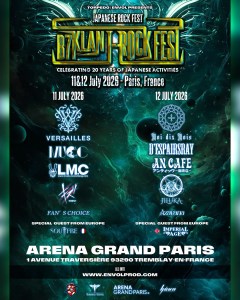
Un grand merci à Elodie et Ellie Promotion pour cette belle opportunité et à Bertrand pour sa disponibilité et ses réponses.
To celebrate the 20th anniversary of B7Klan, a production company specialising in booking artists from Japan, its founder Bertrand Torpedo has decided to launch the B7Klan J-Rock Festival. The festival will take place on July 11th & 12th at the Aréna Grand Paris in Tremblay-en-France (near Paris). The line-up features legends of the genre such as Versailles, An Café, Moi Dix Moi or Mucc, as well as up-and-coming acts like Kizu, Jiluka and Musyozoku, and finally two European bands: SOU/f/FRE and Imperial Age. To find out more about this unique event, we spoke to Bertrand about the story behind its creation, his memories of 20 years of producing Japanese artists, and what you can expect from the festival.
par Victor Brunerie
Victor: I wanted to start by asking you, could you introduce yourself and tell us about B7Klan and Torpedo Prod?
Bertrand: Yeah, well, listen, my name’s Bertrand Torpedo, and I’ve been a show producer for 28 years. So basically, I work with all styles of music, but for the last 20 years I’ve been specialising in Japanese music, and in 2006 I organised my first tourn so this year marks 20 years of touring Japanese artists. Actually, originally, Torpedo Prod was my company where I did a bit of everything, and I set up B7Klan to separate my work with Asian artists from the rest. I was, I don’t know if this means anything to you, but I was the tour manager and producer for Seth Gueko or Alkapote. I was also involved in African music, so when I’d announce Japanese artists, metal fans wouldn’t get it, and neither would rap fans. So that’s actually how B7Klan came about.
Victor: You’re actually organising a festival to celebrate these 20 years, how did this desire to book Japanese artists in general, rock, visual kei, come about?
Bertrand: So here’s the funny thing: it didn’t actually start with me. Before that, I used to organise tours for rock bands, American, British, European, whatever. Then one day, I was contacted by a Japanese rock band, so I put together a tour. I couldn’t believe it, but actually, it was a massive hit. And then, well, a Japanese distribution company saw the tour, got in touch with me and offered me the chance to organise a tour for a Visual Kei band called Dio – Distraught Overlord, which I’d never heard of, and I didn’t know anything about that scene, so I went into it without really believing in it. And actually, it was a massive hit. Anyone who was there can vouch for that. Then other bands got in touch with me, and gradually I was approached more and more. I’ve also become something of a specialist, inevitably, because when you work with these people all the time, you learn the ropes. I’ve been to Japan several times to meet these bands. So there you go, that’s how it all came about.
Victor: It’s true that, for me, I first got to know B7Klan through gigs by bands like Kamijo or Nocturnal Bloodlust, for example.
Bertrand: That was actually me!
Victor: Before we talk about the B7Klan Festival, what are your best memories of B7Klan?
Bertrand : Oh, I’ve got loads of great memories, of course. As for the best ones, I’m not sure. But what’s great about playing with the Japanese, for me, is that it actually took me to the next level. Because back when I was playing in rock bands, let’s say, I was playing venues holding 300 to 500 people, and with the Japanese, I actually went up to 7,000. I started doing my first world tours with Japanese artists, whereas before I’d only been touring Europe. So, naturally, my first time in Brazil was great, it was with a Japanese band. My first Zénith gig was with Joe Hisaishi, whom I produced in 2011. I don’t have fond memories of him personally because he was a tough character, but I do have fond memories of the show, which was extraordinary. I produced Versailles in front of a château near Orléans, that was mad. And then there were loads of great memories linked to the friendships and the human side of working with all those people.
Victor: Let’s talk about the festival taking place on July 11th and 12th. How do you organise such a huge event for its 20th anniversary? Because we’re talking about the Arena Grand Paris!
Bertrand: Well, the advantage for us is that we work with this venue regularly, so we’re already familiar with it. Now, organising a festival is something I’m doing for the first time, and I’ve come to have a lot of respect for everyone who organises festivals. That said, I actually started a year and a half ago. Well, in December 2024, I started looking into it, and it took a whole year just to finalise the line-up. It was incredibly complicated at the time, because, well, even though it’s a niche scene, these are bands that aren’t competing with each other – they just go about their own business, doing their own thing. And then in Japan, there’s a real sense of respect for hierarchies. So they all want to know who’s going to play, who’s going to headline, even though you haven’t sorted that out yet. So, as a result, they put themselves on hold. Anyway, it was a right mess to sort out. But then, at some point, it all fell into place.
Victor: Especially as, on the line-up, I was just about to say, there’s the return of Versailles in France, the Moi Dix Moi tour, and An Café and D’espairsRay reforming too! Did you have any particular aspirations when you first started planning the festival?
Bertrand: Well, actually, if you look at the festival, it’s very well-balanced. Every day, when you’ve got a band, on day A, day B, you’ve almost got its artistic counterpart, you see: LMC and An Café, Moi Dix Moi and Versailles… Of course, they’re not exactly the same, but there’s a sense of balance and, actually, apart from two bands who couldn’t make it, I’ve got exactly the line-up I wanted, so I’m honestly very satisfied, very happy. And the funny thing is, I struggled a bit to put it all together, of course. It didn’t come about that easily, and actuallyn but above alln I didn’t even realise it was such an amazing line-up. I was just focused on the contracts, the preparations… I was right in the thick of it. And when we made the announcements and I saw the global buzz, because, believe it or not, we actually sold 160 tickets to Japanese people, I realised just how mad it all was!
Victor: And then I saw that ticket sales were going well!
Bertrand: We’re really pleased – we’re at over 6,500 across the two days, which isn’t bad. So, well, it would be fantastic and incredible to hit 7,000. But no, that’s very good. What’s great is that none of the bands will have played to such a big crowd in one go outside Japan. So really, they’re all going to find themselves in front of a massive crowd.
Victor: That’s brilliant! And then I noticed that on the line-up, there are obviously the big headliners that people have known for many years and who, for the most part, haven’t played in France for ages. But there are also bands who are, of course, known to Visual fans to some extent, but less so to others. Was it your aim too to showcase up-and-coming bands at the festival?
Bertrand: Well, once again, it’s the same thing – there’s a balance in the line-up which means you do indeed have the veterans, the icons; you’ve got all the styles, virtually every Visual Kei style is represented. And you’ve also got the ‘younger generation’, so to speak, represented, or the future of Visual Kei, with Azavana, Jiluka, and you could even say Kizu. They’re a bit older, but this is their first time in Europe. And they’re still a bit younger than all the others, really. So there, I think there’s a nice balance too. And then, on top of that, I’ll be adding the winner of the competition.
Victor: I was just about to ask a question about that. You’ve actually organised an event in Japan featuring bands using it as a contest to take part in the festival. How do you organise an event like that in another country?
Bertrand: Well, it’s true that at times I find myself thinking: ‘Bloody hell, we’ve gone and set ourselves obstacles and hassles at every turn!’ So, to start with, I go to loads of gigs in really tiny venues in Tokyo – all sorts of genres, actually. And the underground visual art scene does exist. And I was absolutely determined that a band from that underground scene should be featured at the festival so that we really had all the different strata of the visual art scene represented. So, we teamed up with a local magazine, which actually helped us out a lot. Then we hired a venue in Tokyo, the Shibuya Rex, and I’d like to thank the organisers there, who not only threw themselves into it wholeheartedly but are also making the trip to come and see the festival. So that’s really brilliant! And it’s true that the concert, the finale, wasn’t the most complicated part. What was a bit tricky was organising, how shall I put it, the competition, because the Japanese like to be in control, and when they’re not quite sure what they’re getting into or where they’re heading, they hesitate. So, for the competition, we were lucky enough to get quite a few applications from bands, but there were still plenty of bands who didn’t dare to enter, so to speak, because they didn’t know what to expect. We also had bands who didn’t want to play, who didn’t want to take part in the competition because they’d already achieved a certain status. They would have loved to have played at the festival, but they didn’t want to lose out to a smaller band; still, we ended up with about fifty applications. We shortlisted about twenty of them. And then the final, I’m absolutely delighted because all eight bands that made it through were brilliant. It was a concert filmed via livestream, and I think this is the first time it’s been done on video. And the production was good. We had over 10,000 viewers tuned in to watch bands that people don’t know much about, or perhaps not at all. So yeah, I’m absolutely thrilled about this whole adventure. And on top of that, the fact that people in the audience want to come and see us because they thought it was cool is brilliant. There were loads of other people too who didn’t understand our approach to this competition at first, but who, when they saw the livestreamed final, thought it was really cool to discover so many new small bands through this competition. So there you go, it was yet another complication, but in the end it worked out.
Victor: So, the winner will be playing on the first day, is that right?
Bertrand: That’s right! It’ll be the band Musyozoku.
Victor: It’s a tough line-up for the festival, you’ve also chosen to include two European bands: SOU/f/FRE on the first day and Imperial Age on the second. Was that perhaps also a desire to show that there are scenes, not necessarily inspired by the ‘visu’ style, but which still tap into that artistic side of ours?
Bertrand: Absolutely! Now, we do have ‘visu’ bands in Europe, but in this case, I chose to pick bands that still have a strong visual aesthetic. So SOU/f/FRE, well, there’s no denying it, they tick all the boxes. And Imperial Age are a different style, but they’ve still got a visual element, they wear costumes, there’s a whole stage set-up, so for me, they definitely belong at this festival. And what’s funny, actually, is that Imperial Age probably have the most Spotify listeners of all the bands at the festival. But of course, as they’re in a different world to the visual scene, people probably don’t realise that.
Victor: The festival’s coming up soon, just under a month away now. How are you feeling as the event approaches?
Bertrand: We’re on schedule, but that doesn’t mean we’re sitting back and doing nothing. The nights are short at the moment because we want to sort everything out, but for now, all the flights are booked. There are 85 flights to organise from Japan, but everything’s sorted, the hotels are booked, the venue’s booked, the technical set-up’s sorted, so now we’re really just in the final stages of organisation, like sending out the schedules to the artists, volunteers and staff who’ll be there, so that on the day, everyone’s in the right place and does what they’re supposed to do. So today, I’m fine, I’ve got no reason to worry. That said, we’re keeping a close eye on things and really trying to make sure everything’s just perfect.
Victor: And as you’re located next to the airport, it’s quite straightforward for the Japanese bands coming over.
Bertrand: Yeah, there’s a practical side to it. And we’re also right next to Japan Expo, which is taking place at the same time, and we’re inviting people attending that to come to our festival if they fancy it.
Victor: What sort of feedback did you get when you first set up the festival?
Bertrand: Well then, I think we’ve had a really good response. Of course, at the start, whilst the line-up hadn’t been announced yet, people were inevitably saying: “Oh, B7Klan – they’re organising a festival. We’ll see about that.” But it’s true that we announced the bands one by one each day, and that’s when the hype really took off, it was incredible, truly exceptional. We could see that at 5.00 pm, when we announced the next band, by 5.05 pm, the likes and comments would just explode. So I think the response was very good and, in any case, if you like the visual style and you’re looking for faults, you can find faults with loads of things, but if you’re criticising this line-up even though you like the Visu style, well, in reality, it just means you don’t actually like the visu style.
Victor: It’s true that when we saw the line-up in the media, we thought we were heading to a massive festival! And even bands like Jiluka, who we didn’t know, look brilliant!
Bertrand: That’s great! But you know, as it turns out, Jiluka are actually quite well-known.
Victor: Yeah, I saw they played at Resurrection Fest last year.
Bertrand: Yeah, they’re quite well known; they’ve also played at Rock for People in the Czech Republic. And actually, what’s funny, and really nice, is that Jiluka fans don’t necessarily know Moi Dix Moi or An Café. So each band has its own fans. That means everyone can make the most of the festival to discover new things.
Victor: As someone who often goes to Japan, what are your most memorable experiences of Visual Kei or Japanese rock?
Bertrand: I’m going to mention an event I was lucky enough to take part in: the VKey Festival in Tokyo. There were some incredible bands there. I think it was in 2007 or 2008, and it was a massive festival with 20,000 people, so there really were some incredible bands, loads of visual kei bands. And they had two stages, one on each side of the venue. So when the band on the left finished playing, everyone would turn round and head to the right. Meanwhile, the next band was getting ready. So actually, it was really, really impressive. It was funny, though, the headliner was Marilyn Manson. It was this non-Japanese band that was there. And incidentally, it was the first time I’d seen Marilyn Manson; it was cool. There were 20,000 people there, and here’s a little anecdote: as we were leaving the concert, there were hundreds of visual kei but underground bands handing out their band’s flyers. I made the most of it and collected all the flyers. Then, at the hotel and on the plane, I pored over them all, studied them carefully, and got in touch with a few bands, including one I ended up working with. I organised two European tours for a band who’d handed me their flyer in the street and whose music I really liked. And then, the second rather incredible memory I have was actually Versailles in front of the castle near Orléans, that was absolutely stunning.
Victor: Well, anyway, Versailles in from of a castle, from that point on…
Bertrand: Ah yeah, but that’s not all. I mean, actually, that day was in mid-October and the weather was absolutely lovely, it was really hot. It was something we weren’t expecting, and everything was perfect, so I’ve got really fond memories of it.
Victor: And finally, to wrap up, our media outlet is called Sounding Shivers and we like to finish with a question asking which artists are giving you goosebumps at the moment?
Bertrand: Well, listen, unfortunately I’m rather old school, so it’s rare for new artists to really get me going. But for example, I’m a fan of an American band called Suicidal Tendencies. In fact, that’s a Suicidal Tendencies T-shirt over there (the T-shirt is framed in his office, ed.). Also, yesterday I went to see Cypress Hill, honestly, it was brilliant, I loved it. But on the other hand, if we’re talking about Japanese acts at the festival, I’m looking forward to seeing people’s reactions when they go to see Musyozoku, because when they won the competition, well, I was pretty neutral, I didn’t even vote – but I thought their performance was good. They invited me to a gig they were playing three or four days later. Plus, they’d won the competition, so there was a really good vibe and I thought it was incredible. And I think there are loads of bands at the festival that I like, but as with Musyozoku, nobody really knows them, so I reckon they’re going to make a huge splash.
Victor: The Japanese band I’d love to see come to Europe is Nothing’s Carved In Stone. It’s my dream to see them turn up here.
Bertrand: Oh, well, you see, I didn’t know them.
Victor: They’re a band who’ve already released quite a few albums, but their style is more rock than visual kei. The bassist is incredible and the albums really go down a treat.
Bertrand: Well, I’ll make a note of it. I’ll write down the name and then we’ll see if we can do something about it.
Victor: Thank you very much, Bertrand, for your answers, and I’m looking forward to the festival!
Bertrand: Well, thank you too. Say hello to the whole team for me, and we’ll be waiting for you on the 11th and 12 of July.
We leave you with the festival poster and the link to the tickets to snatch one before it’s too late.

