A l’occasion de la sortie de VOICES, quatrième album de Not Scientists, nous avons échangé avec Ed (chant / guitare) et Tatane (basse). Nous avons pu aborder le processus de composition, l’évolution du groupe, des sonorités,… et bien sûr la tournée à venir !
Interview par Mégane Canis et Victor Brunerie
Crédit photo de couverture : Michael Fasching
English version below
Mégane : Vous sortez VOICES qui est le quatrième album, en plus de tous les EP. On y retrouve un line-up différent à la composition (même si ce line-up est déjà en place depuis quelques temps), avec l’arrivée de Fred à la guitare, quelle influence cela a eu dans le processus de création de cet album?
Ed : Ca a changé plein de choses parce que Fred a un jeu vraiment particulier et une manière d’appréhender la musique qui lui est propre et ça s’entend tout de suite dans les parties de guitare qu’il a écrites. Il y a un brin de folie, un peu de complexité et du sang neuf, des nouvelles idées. Ça nous a aidé à faire évoluer le son et aussi une autre manière de composer. Je pense que même pour ceux qui connaissent pas Fred, en tendant un peu l’oreille y’a moyen de comprendre les moments où c’est lui qui joue.
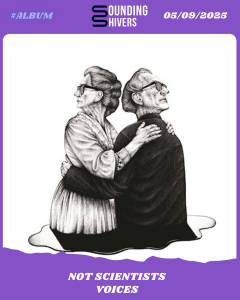
Mégane : Justement vos sonorités sont de plus en plus complexes album après album vous allez toujours chercher quelque chose, et on le voit aussi dans vos pochettes, au niveau des visuels. Celle de VOICES est notamment pleine de sens, est-ce que vous pouvez nous parler un petit peu de cet artwork qui assez incroyable?
Ed : Toutes nos pochettes sont faites par la même personne : Ulrich Totier qui est un ami de longue date : illustrateur, graphiste et tatoueur. On lui confie toujours nos pochettes et c’est vrai que chaque album a des pochettes qui à chaque fois donnent à réfléchir. C’est jamais des images évidentes et c’est ce qu’on aime dans ces pochettes : tu regardes et tu te dis “qu’est ce que ça veut dire?” et chacun va trouver quelque chose de différent.
Mégane : Oui c’est vrai que celle-ci a différents niveaux de lecture, entre les personnes qui s’enlacent, qui fondent et qui en même temps regardent dans différentes directions… Elle est vraiment complexe celle-ci et reflète votre évolution d’album en album…
Ed : Ouais carrément et c’est des personnes âgées sur la pochette et il y a une deuxième illustration qui reprend le même thème mais les personnages sont jeunes. Qui sera faite en t-shirt bientôt, pour la nouvelle tournée. Et tout ça ça change complètement le sens de l’illustration et l’interprétation aussi.
Victor : On entend de plus en plus d’influences différentes dans vos titres, en particulier des choses comme le post-punk et même un peu de post-rock dans des titres comme “Ball and Chain” qui est un des titres qui nous a vraiment marqué sur l’album. Est-ce que c’est un style vers lequel vous dérivez consciemment ou inconsciemment lentement ou c’est juste par hasard que vous tombez vers ces influences là au fil des albums?
Tatane : Alors non pas vraiment parce qu’on baigne là dedans, on a ces influences là.
Victor : en même temps avec le t-shirt Russian Circles j’avais peu de doute (ndlr : Tatane porte un t shirt de ce groupe) *rires*
Tatane : Ouais, bon voilà, le t-shirt parle pour moi-même. T’abordais les sonorités un peu plus post ou ce genre de choses. Là je pense qu’on l’a intégré sur des morceaux comme “Architects” où c’était quand même vachement plus ambiant, et c’est d’autres textures qu’on aborde. Et c’est hyper cool de pouvoir développer ce genre de choses.
Ed : Le groupe est en constante évolution en fait quand t’écoutes tous les disques. Et chaque nouvel album ressemble un peu à celui d’avant mais il y a toujours des nouvelles choses, des nouvelles textures. Et en fait, on découvre des trucs qui nous plaisent, qu’on va poursuivre ou pas sur les prochains disques selon à quel point on a kiffé. On s’amuse, on trouve des nouveaux jouets, des nouveaux tricks et on joue avec jusqu’à ce qu’on s’en lasse. *rires*
Mégane : Même par moments dans l’album, on a trouvé des petits passages presque un peu pop, un peu rock, en tout cas des choses très accessibles avec des refrains un peu catchy qui accrochent vraiment… Des choses très efficaces, est ce que c’était aussi une volonté ce côté accessible sur certains titres?
Ed : Alors il n’y avait pas une volonté de faire quelque chose de plus accessible par contre il y avait une volonté de revenir un petit peu aux refrains, qu’il y avait un peu moins sur le dernier disque. Parce qu’on s’est aventuré sur d’autres plans : plus des recherches de sons, d’ambiances. Et là il y a eu une envie générale au sein du groupe de refaire un peu des refrains donc … bah on a fait des refrains !
Tatane : C’est cool que vous l’ayez déjà perçu, donc déjà ça nous fait plaisir !
Ed : Ouais on a réussi! *rires*
Mégane : Il y a des morceaux, certains, qui sont très taillés pour la scène. Est ce que ça aussi ça se fait quand vous composez, vous vous dites “celui-là on le fait en pensant à la scène” ou est-ce que vous êtes que dans la composition et c’est après que vous voyez lesquels sont les plus efficaces?
Ed : Ouai c’est quand on se met à les répéter, il y a un moment, certains morceaux on se dit “celui-là il va être cool sur scène, il va être fun”
Tatane : Il y a des petits regards qui font qu’on se dit “ça ouai”
Ed : Il y a un morceau, c’est “BURN OUT”, celui-ci il est un peu plus punk rock, un peu plus tout droit quoi. Et on s’est dit “celui-là il va être cool à jouer sur scène”
Tatane : Et moi ça m’a fait cette sensation surtout, quand on était en train d’enregistrer. Parce que là, la magie opère, y’a tout qui est en train de s’empiler, s’emboîter … Et là tu vois une autre perspective, que t’avais pas forcément au début dans la composition. Et après quand tu reçois le mix, le master, tu t’aperçois que tu peux changer d’avis et les morceaux prennent généralement une autre ampleur une fois que c’est passé dans les mains de chez Santi Garcia
Ed : Ouai c’est souvent en fait, qu’en sortant de studio, nos morceaux préférés à chacun changent, une fois les morceaux finis. Parce qu’on redécouvre certains titres où on se dit “ah ouai putain il sonne vraiment pas comme je pensais”. Et des fois le morceau change presque un peu de style une fois qu’on a bidouillé nos pédales, changé un peu des parties, le mix… Y’a des morceaux qui se révèlent et ça c’est cool.
Victor : Justement, depuis les derniers albums on disait que vous aviez un peu pris un virage “stylistique”. Est ce que vous avez eu des gens qui ont pu “reprocher” le virage un peu moins punk rock, et est-ce que vous sentez que ça évolue en terme de public qui vient à vos concerts ou fait des retours sur vos albums?
Ed : Alors nous on a eu aucun reproche. Nous on n’a pas vécu ça comme un virage, on a vécu ça comme une évolution naturelle. En vrai si t’écoutes le deuxième album, Golden Staple il y avait déjà des indices de textures et de sons qui tendaient vers ça. Et nous on n’a pas le sentiment d’avoir pris un virage. Après il y a eu la période COVID entre les deux, et c’est vrai que ce temps tout seul à la maison, à composer, ça a peut-être laissé un peu de place, un peu plus de folie que d’habitude. Alors peut-être qu’on a évolué un peu plus vite et dans l’ombre. Et du coup, pour nous ça paraît naturel mais peut-être que quand l’album est sorti il y a des gens qui ont été un peu surpris, mais personne ne nous l’a reproché
Tatane : Ou ils l’ont jamais dit ! *rires*
Mégane : vous restez toujours sur cette base de punk rock, vous restez dans cet univers, notamment sur les tournées où vous êtes avec des groupes de cette famille. C’est quoi pour vous vraiment l’essence du punk rock? Qu’est ce qui fait que c’est punk rock et qu’est ce qui fait que si on enlève ça, c’est plus du tout du punk rock?
Ed : Nous on joue dans des groupes depuis longtemps, on a joué dans plein de groupes avant. Et c’est tout à la démerde. On a joué dans des groupes différents : des groupes de hardcore, des groupes punk rock, des groupes un peu plus pop… Mais la manière de fonctionner a toujours été la même : c’est essayer de faire le maximum avec peu. Donc pas mal à galérer, à se démerder, à faire les choses avec des bouts de ficelle. Et pour moi le punk rock c’est un peu ça. C’est faire comme on peut avec pas grand chose, et faire de bons morceaux sans savoir forcément jouer bien.
Mégane : Un peu le côté DIY quoi…
Ed : Ouais! Mais par rapport à la question d’avant, ça me revient, tu demandais si on avait senti un effet sur le public. Effectivement, j’ai l’impression qu’il y a des gens qui n’auraient pas écouté notre groupe avant qui nous écoute aujourd’hui. Ça intéresse d’autres personnes. Ça oui, on l’a ressenti. Mais j’ai pas l’impression qu’on ai perdu ceux qui nous suivaient depuis le début. Parce que justement c’est pas vraiment un virage et je pense qu’on nous reconnaît tout de même
Victor : Justement sur les tournées après Staring at the Moon et Staring at the Sun, comment ces derniers temps vous revoyez ces années post-covid où vous avez repris la scène tout ça. Comment vous avez vécu ces années-là en tant que groupe?
Tatane : Ah bah on était juste comme des dingues de pouvoir refaire de la musique, de pouvoir se revoir, de pouvoir faire des kilomètres, revoir les gens, revoir les copains et faire ce qu’on aime quoi.
Ed : Bah là pour le coup quelque soit notre domaine d’activité ou nos occupations, je crois que tout le monde a vécu la même chose en même temps : “On va pouvoir reprendre notre vie et faire les trucs qui nous font kiffer”. Pour nous c’était reprendre la route pour d’autres c’est autre chose. Mais là je pense que tout le monde a vécu le même sentiment au même moment.
Mégane : Dans VOICES vous partagez une certaine vision du monde. Quel est votre regard à vous : est-ce que vous êtes plutôt optimistes en vous disant qu’il y a des choses qui bougent et que ça va avancer, ou plutôt pessimistes?
*Rires de Tatane et Ed*
Mégane : Ou un truc entre les deux !
Ed : Alors, les paroles de VOICES sont plutôt pessimistes mais ça veut pas dire pour autant qu’on n’a pas une vision optimiste. C’est des ressentis sur le moment parce qu’on est entourés de tellement de nouvelles négatives, et on a vraiment le sentiment que le monde va dans le mauvais sens là en ce moment, à tous les niveaux, que voilà c’est des ressentis couchés sur le papier mais bon. Peut-être que le monde évolue d’une manière où pour faire deux pas en avant des fois on fait un pas en arrière. Et j’ai l’impression qu’on est au moment du pas en arrière. J’espère que ça sera suivi de deux pas en avant.
Mégane : Justement, le fait des fois de coucher ces mots négatifs, ça permet de se libérer de ce pessimisme ambiant?
Ed : Ouais moi je sais que c’est ma manière de m’en libérer. Plutôt que d’aller voir un psy, écrire tous les trucs sombres qui me passent par la tête sur papier, ça me permet de les expulser.
Victor : On voulait vous poser une petite question “curiosité” pour la prochaine tournée : vous deviez jouer au Poche de Béthune (et sur d’autres dates) avec Bad Bad Bird. On sait que Mado attend un heureux évènement, et on est ravis pour elle. Est- ce que vous avez déjà trouvé quelqu’un pour prendre ces dates là avec vous, ou est-ce que vous verrez localement?
Ed : C’est en cours je crois. C’est une info toute fraîche, il n’y a rien d’annoncé encore mais il me semble qu’il y a un nom de groupe qui circulait là que je n’ai plus en tête. Dès qu’on saura on l’annoncera. Le lendemain, on joue à Nevers avec Lou K, un groupe de punk belge, mais je ne sais pas si c’est pour Béthune.
Victor : Dans tous les cas on sera présents ! (Ndrl : Depuis c’est le groupe lillois Ipkiss qui a été annoncé en première partie de cette date. )
Mégane : Chez Sounding Shivers, on ne se limite pas dans les styles musicaux, tant que ça nous donne des frissons, d’où le nom du média. Quels sont vos groupes du moment qui vous donnent des frissons, qui vous font vraiment vibrer?
Ed : Alors ça c’est une question vaste. Parce qu’on est quatre dans le groupe, et on a des choses en commun, mais à côté de ça, on écoute des trucs totalement différents. Ça va du jazz au blues en passant par le flamenco, la pop, le RnB, le hardcore, le punk, le metal, donc… Moi pour ma part, ces derniers temps, le groupe qui m’a fait vraiment kiffé et qu’on est monté voir à l’Olympia, c’est un groupe qui s’appelle Bleachers. C’est un groupe du New Jersey et le chanteur c’est Jack Antonoff, qui est un producteur de pop. Il produit des trucs comme Taylor Swift, ce que j’ai appris plus tard. Mais son groupe Bleachers ça a été mon coup de coeur de ces dernières années et le concert m’a foutu la chair de poule.
Tatane : Et moi j’oscille en ce moment entre le dernier Fontaines D.C et jusqu’au dernier Russian Circles
Victor : Justement pour avoir vu Fontaines D.C il n’y a pas longtemps à Cardiff…
Tatane : Ah tu les as vus ! T’étais au concert au château??
Victor : Au château de Cardiff ouai
Tatane : Wouah ça devait être énorme !
Victor : C’était énorme. Le public britannique c’est un autre niveau. Nous on est considérés comme un bon public en général par les artistes étrangers. Mais au Royaume-Unis c’est un autre niveau. Dès High Vis c’était parti.
Tatane : J’ai vu justement le live de High Vis, complètement fou!
Ed : Ouais parce que nous on a fait deux dates avec High Vis justement il n’y a pas longtemps en Espagne et c’était très très cool parce que c’est un groupe qu’on a vraiment kiffé ces dernières années. Et ils vont faire la tournée avec Turnstile là…
Tatane : ils ont fait Deftones, là ils partent avec Turnstile… C’est en train de devenir énorme !
Victor : Mais oui Fontaines DC c’est les patrons dernièrement.
Tatane : Oui et c’est rigolo parce qu’on parlait d’évolution. Eux aussi, on les a connus il y a très longtemps, ils avaient sorti juste des singles ce genre de trucs. Et du coup tu peux voir aussi l’évolution d’un groupe dans la pop comme ça que du coup je trouve remarquable.
Ed : Mais vraiment avec Not Scientists, on n’a jamais essayé de ressembler à un autre groupe. Et il y a eu un moment où on a trouvé des sons qui nous plaisaient et on a collé un peu à ces sons -les guitares très claires…- mais en ajoutant un peu des ingrédients au fur et à mesure. On a eu la chance d’avoir trouvé une base de son qui nous plaît parce que ça c’est ce qu’il y a de plus dur je pense pour un groupe. Et puis on arrête pas de mettre des ingrédients en plus à chaque album.
Tatane : Tout en gardant une identité.
Mégane & Victor : Un grand merci à vous deux! A très vite.
Tatane et Ed: Merci à vous!
Un grand merci à Romain et Agence Singularité pour l’opportunité et à Ed et Tatane pour leurs réponses, leur bonne humeur et leur disponibilité.
To mark the release of VOICES, Not Scientists’ fourth album, we spoke with Ed (vocals/guitar) and Tatane (bass). We discussed the songwriting process, the band’s evolution, their sound… and, of course, their upcoming tour!
Interview by Mégane Canis et Victor Brunerie
Picture taken by : Michael Fasching
Mégane: You’re releasing VOICES, your fourth album, in addition to all the EPs. There’s a different line-up on the album (even though this line-up has been in place for some time now), with Fred joining on guitar. How did that influence the creative process for this album?
Ed: It changed a lot of things because Fred has a really unique style and his own way of approaching music, and you can hear that right away in the guitar parts he wrote. There’s a touch of madness, a bit of complexity and some new blood, new ideas. It helped us to develop our sound and also to compose in a different way. I think that even for those who don’t know Fred, if you listen carefully, you can tell when it’s him playing.
Mégane: Your sound is becoming more and more complex with each album, you’re always looking for something new, and we can see that in your album covers too, in terms of the visuals. The cover for VOICES is particularly meaningful, can you tell us a little bit about this incredible artwork?
Ed: All our album covers are designed by the same person: Ulrich Totier, who is a long-time friend: illustrator, graphic designer and tattoo artist. We always entrust him with our album covers, and it’s true that each album has covers that make you think. The images are never obvious, and that’s what we love about these covers: you look at them and ask yourself, ‘What does this mean?’ and everyone sees something different.
Mégane: Yes, it’s true that this one has different levels of interpretation, between the people who are embracing, melting and at the same time looking in different directions… It’s really complex and reflects your evolution from album to album…
Ed: Yeah, absolutely, and there are elderly people on the cover, and there’s a second illustration that takes up the same theme, but the characters are young. It will be made into a T-shirt soon, for the new tour. And all that completely changes the meaning of the illustration and the interpretation too.
Victor: We’re hearing more and more different influences in your tracks, particularly things like post-punk and even a bit of post-rock in tracks like ‘Ball and Chain’, which is one of the tracks that really stood out for us on the album. Is this a style you’re consciously or unconsciously drifting towards, or is it just by chance that you’re falling into these influences over the course of your albums?
Tatane: Well, not really, because we’re immersed in it, we have these influences.
Victor: At the same time, with the Russian Circles T-shirt, I had little doubt (editor’s note: Tatane is wearing a T-shirt from this band) *laughs*
Tatane: Yeah, well, the T-shirt speaks for itself. You mentioned sounds that are a bit more post-rock or that kind of thing. I think we’ve incorporated that into tracks like ‘Architects’, which was a lot more ambient, and we’re exploring other textures. It’s really cool to be able to develop that kind of thing.
Ed: The band is constantly evolving when you listen to all the records. And each new album is a bit like the one before, but there are always new things, new textures. And in fact, we discover things we like, which we may or may not continue on future albums depending on how much we enjoyed them. We have fun, we find new toys, new tricks, and we play with them until we get tired of them *laughs*.
Mégane: Even at times in the album, we found little passages that were almost a bit pop, a bit rock, in any case very accessible things with slightly catchy choruses that really grab you… Very effective stuff. Was it also intentional to make certain tracks more accessible?
Ed: Well, it wasn’t intentional to make something more accessible, but we did want to return a little to the choruses, which were a little less present on the last album. Because we ventured into other areas: more research into sounds and atmospheres. And then there was a general desire within the band to bring back the choruses a bit, so… well, we wrote some choruses!
Tatane: It’s cool that you’ve already noticed that, so we’re happy about that!
Ed: Yeah, we did it! *laughs*
Mégane: Some of the songs are really well suited to live performance. Is that something you think about when you’re writing, like, ‘let’s write this one with live performance in mind’, or do you just focus on the writing and then see which ones work best?
Ed: Yeah, it’s when we start rehearsing them, there’s a moment when we say to ourselves, ‘This one’s going to be cool on stage, it’s going to be fun.’
Tatane: There are little glances that make us say, ‘Yeah, that’s it.’
Ed: There’s one track, ‘BURN OUT’, which is a bit more punk rock, a bit more straightforward. And we thought, ‘This one’s going to be cool to play live.’
Tatane: And that’s the feeling I got, especially when we were recording it. Because that’s when the magic happens, everything comes together, fits together… And then you see another perspective that you didn’t necessarily have at the beginning of the composition. And then when you get the mix, the master, you realise that you can change your mind and the songs usually take on a whole new dimension once they’ve been through Santi Garcia’s hands.
Ed: Yeah, it’s often the case that when we leave the studio, our favourite tracks change once they’re finished. Because we rediscover certain tracks and think, ‘Oh yeah, damn, it really doesn’t sound like I thought it would.’ And sometimes the track changes style a little once we’ve fiddled with our pedals, changed some parts, the mix… Some tracks reveal themselves and that’s cool.
Victor: Precisely, since the last few albums, people have been saying that you’ve taken a bit of a ‘stylistic’ turn. Have you had people who have ‘criticised’ the shift away from punk rock, and do you feel that this is changing in terms of the audience that comes to your concerts or gives feedback on your albums?
Ed: Well, we didn’t get any criticism. We didn’t see it as a turning point, we saw it as a natural evolution. Actually, if you listen to the second album, Golden Staple, there were already hints of textures and sounds that were moving in that direction. And we don’t feel like we’ve taken a turn. Then there was the COVID period in between, and it’s true that all that time alone at home, composing, perhaps left a little more room for a little more madness than usual. So maybe we evolved a little faster and in the shadows. And so, for us it seems natural, but maybe when the album came out there were people who were a little surprised, but no one criticised us for it.
Tatane: Or they never said anything! *laughs*
Mégane: You always stay true to your punk rock roots, you stay in that world, especially on tour when you’re with bands from that family. What is the essence of punk rock for you? What makes it punk rock and what is it that, if you take it away, makes it no longer punk rock?
Ed: We’ve been playing in bands for a long time, we’ve played in lots of bands before. And it’s all about getting by. We’ve played in different bands: hardcore bands, punk rock bands, bands that are a bit more pop… But the way we work has always been the same: trying to do as much as possible with as little as possible. So it’s been a lot of hard work, figuring things out, doing things with whatever we had. And for me, that’s what punk rock is all about. It’s doing what you can with what little you have, and making good songs without necessarily knowing how to play well.
Mégane: A bit of a DIY vibe…
Ed: Yeah! But going back to the previous question, you asked if we felt an effect on the audience. Actually, I do feel that there are people who wouldn’t have listened to our band before who are listening to us now. It interests other people. Yes, we’ve felt that. But I don’t feel like we’ve lost the people who’ve been following us since the beginning. Because it’s not really a change of direction, and I think people still recognise us.
Victor: Speaking of the tours after Staring at the Moon and Staring at the Sun, how do you feel about those post-Covid years when you got back on stage and all that? How did you experience those years as a band?
Tatane: Well, we were just crazy about being able to make music again, seeing each other again, travelling miles, seeing people again, seeing our friends again and doing what we love.
Ed: Well, regardless of what we do for a living or what we’re busy with, I think everyone felt the same thing at the same time: ‘We’re going to be able to get our lives back and do the things we love.’ For us, that meant getting back on the road; for others, it meant something else. But I think everyone felt the same way at the same time.
Mégane: In VOICES, you share a certain vision of the world. What is your perspective: are you more optimistic, telling yourselves that things are changing and that progress will be made, or are you more pessimistic?
*Tatane and Ed laugh*
Mégane: Or something in between!
Ed: So, the lyrics of VOICES are rather pessimistic, but that doesn’t mean we don’t have an optimistic outlook. These are feelings we have at the moment because we’re surrounded by so much negative news, and we really feel that the world is going in the wrong direction right now, on all levels. These are feelings put down on paper, but anyway. Maybe the world is evolving in such a way that to take two steps forward, sometimes you have to take one step back. And I feel like we’re at the point of taking a step back. I hope it will be followed by two steps forward.
Mégane: Precisely, does putting these negative words down on paper sometimes help to free you from this prevailing pessimism?
Ed: Yeah, I know that’s how I free myself from it. Rather than going to see a therapist, writing down all the dark thoughts that go through my head allows me to expel them.
Victor: We wanted to ask you a little ‘curious’ question about the upcoming tour: you were supposed to play at the Poche de Béthune (and on other dates) with Bad Bad Bird. We know that Mado is expecting a happy event, and we’re delighted for her. Have you already found someone to take those dates with you, or will you see locally?
Ed: I think it’s in the works. It’s breaking news, nothing has been announced yet, but I think there was a band name floating around that I can’t remember. As soon as we know, we’ll announce it. The next day, we’re playing in Nevers with Lou K, a Belgian punk band, but I don’t know if it’s for Béthune.
Victor: In any case, we’ll be there! (Editor’s note: Since then, the Lille band Ipkiss has been announced as the opening act for this date. )
Mégane: At Sounding Shivers, we don’t limit ourselves to any particular musical style, as long as it gives us chills, hence the name of the media outlet. Which bands are giving you chills right now, really getting you excited?
Ed: That’s a big question. There are four of us in the band, and we have things in common, but apart from that, we listen to totally different stuff. It ranges from jazz to blues, flamenco, pop, RnB, hardcore, punk, metal, so… For me, lately, the band that I’ve really been into and that we went to see at the Olympia is a band called Bleachers. They’re a band from New Jersey and the singer is Jack Antonoff, who’s a pop producer. He produces stuff like Taylor Swift, which I found out later. But his band Bleachers has been my favourite in recent years and the concert gave me goosebumps.
Tatane: And right now, I’m oscillating between the latest Fontaines D.C. and the latest Russian Circles, to give you an idea of the range. It goes from pop to Oï…
Victor: Actually, I saw Fontaines D.C. not long ago in Cardiff…
Tatane: Oh, you saw them! Were you at the concert at the castle?
Victor: At Cardiff Castle, yeah.
Tatane: Wow, that must have been huge!
Victor: It was huge. British audiences are on another level. We’re generally considered a good audience by foreign artists. But in the United Kingdom, it’s on another level. As soon as High Vis came on, it was off.
Tatane: I saw High Vis live, it was completely crazy!
Ed: Yeah, because we did two dates with High Vis not long ago in Spain and it was really cool because they’re a band we’ve really enjoyed over the last few years. And they’re going on tour with Turnstile now…
Tatane: They did Deftones, now they’re going with Turnstile… It’s getting huge!
Victor: Yeah, Fontaines DC are the bosses lately.
Tatane: Yeah, and it’s funny because we were talking about evolution. We’ve known them for a long time too, they had just released singles and stuff like that. And so you can also see the evolution of a pop band like that, which I find remarkable.
Ed: But really, with Not Scientists, we never tried to sound like another band. There was a point where we found sounds we liked and stuck with them a bit – very clear guitars, for example – but we added a few ingredients as we went along. We were lucky to find a sound we liked because I think that’s the hardest thing for a band. And then we keep adding ingredients to each album.
Tatane: While maintaining an identity.
Mégane & Victor: A big thank you to both of you! See you soon.
Tatane and Ed: Thank you!
A lire aussi / Also to be read :
 Sounding Shivers
[…] “ENDGAME” et “BURNOUT”. Le groupe nous avait d’ailleurs évoqué ce dernier titre lors de leur interview, disant qu’il serait cool à jouer. Et bien il est également très chouette à entendre sur […]
J’aimeJ’aime