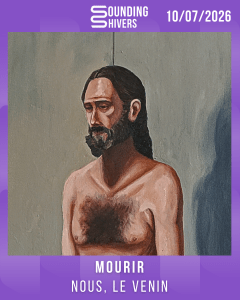
À l’occasion de leur passage au Rock In Bourlon, quelques jours avant la sortie de Nous, le venin, nous avons rencontré Olivier et Maël de Mourir. L’occasion d’évoquer la genèse de ce nouvel album, l’évolution de leur identité musicale entre black metal, doom et post-metal, mais aussi les thématiques qui l’habitent : individualisme, désillusion et recherche d’un nouvel élan collectif. Une conversation sincère autour d’un disque qui conjugue regard critique sur notre époque et volonté de ne pas céder au fatalisme.
Interview par Marye Davenne
Crédit photo de couverture : Jodie Roszak
English version below
Marye : Vous revenez tout juste du Hellfest, le week-end dernier, comment ça s’est passé?
Maël : C’était très bien, c’était rapide, assez efficace parce que c’est une grosse machine, donc ça tourne beaucoup. En gros, on est arrivé, on a fait une balance, on a attendu 5 minutes et on a joué, on est parti.
Olivier : On est resté la journée quand même.
Maël : Oui, on est resté.
Olivier : Le lendemain matin, on est reparti. On a eu un super accueil technique, des gens qui travaillent là-bas. Et en tant que groupe, c’était chouette, il y avait beaucoup de public qui étaient là, c’était blindé dans la tente jusqu’au bout.
Marye : C’était un horaire où tu peux te demander si les gens vont être levés ?
Maël : Oui, mais c’était plein et puis devant, il y avait tous les gens qui faisaient la queue pour acheter un truc du merch du Hellfest, du coup, visuellement, c’était à perte de vue donc c’était impressionnant.
Marye : Vous vous apprêtez à sortir votre album Nous Le Venin, dans 2 semaines à peu près (au moment de l’interview). Vous avez déjà eu l’occasion de jouer des morceaux, notamment peut-être au Hellfest?
Olivier : La première fois c’était au Frozen Fest en juin. On a 3 nouveaux morceaux dans notre set, on les a joué au Hellfest et on les jouera également ce soir.
Marye : Quels ont été les premiers retours sur ces titres ?
Olivier : Ben, on a un morceau en particulier, « Nous, le venin » qui est la première du set, où il y a un riff qu’on répète 32 fois, je crois, très hypnotique. J’ai l’impression que ce truc percute bien les gens en live parce que ça te met dans une trans.
Marye : Bah c’était une question pour après, mais du coup, vu que tu en parles maintenant, je vais la faire tout de suite. Moi, je trouvais, notamment avec ce riff-là, c’est celui de l’album qui vous met le plus au milieu de plusieurs genres. Parce qu’au final, l’étiquette qui est mis sur votre musique c’est « black metal expérimental » mais ce riff fait très post-métal. On a parfois des moments aussi assez doom quand même, c’est hyper lent. Est-ce que c’est important d’être un peu à la croisée des styles musicaux ?
Olivier : On a vite fait le tour d’un stylé musical et puis il y a déjà 650000 groupes qui ont fait ça. Donc on a eu d’autres inspirations et notamment moi, je suis plutôt black métal tradi et les autres gars qui écoutent pas du tout du black métal. Ils ont amené un peu leur touche, qui est plus sludge, qui est plus musique du monde, rock années 70. Et là, on a intégré Théophile qui joue dans Bruit ≤, depuis maintenant 2 ans dans le groupe. Et lui, il a apporté beaucoup plus de texture noise rock dans le groupe et on le laisse s’exprimer le plus possible. Et du coup, son travail du son mélangé à nos compos un peu froides, ça donne un mélange de plein de genres différents. Donc le côté riff hyper répétitif, trans, pour moi, ça vient du black métal parce qu’il y a beaucoup de groupes comme ça qui répètent les riffs, beaucoup pour se mettre en trans. Mais après tout le travail du son, le travail autour des passages un peu Doom et tout, c’est des choses qui viennent pas du black et qui viennent de Théo, il adore le Doom, il rêvait de faire un passage un peu comme ça dans notre groupe, dans notre musique.
Marye : Parce qu’à la base, Mourir c’est un projet solo.
Olivier : Alors, à la base de la base, c’est une continuité de mon projet solo qui s’appelait Vermine, qui n’est pas le groupe facho parce qu’il y a un vermine facho qui existe et on tient à préciser que c’est monté après moi. Bref, donc ce projet vermine, j’ai voulu sortir un projet One man band où je fais la guitare basse batterie, je l’ai mis sur bandcamp, j’ai fait des cassettes et terminé, je passe à autre chose. Et les gars, Maël et Alex m’ont dit vas-y, faut qu’on fasse un groupe de ça, c’est cool, faut qu’on fasse des concerts et j’ai dis ouais OK, pourquoi pas. Donc à la base c’était un peu mon ADN, le black metal tradi et au final maintenant on est 4. Ce n’est pas mon groupe, c’est notre groupe et ils ont leur mot à dire.
Maël : On évolue à partir du premier album qui était plus classique, plus black metal. C’est vrai que maintenant on a un peu moins peur d’aller dans des directions un petit peu différentes en gardant cette base je pense. Mais ce qu’on aime dedans, c’est cette sensation de répétition. Ça fait vraiment partie du black metal. Le truc où t’arrives à rentrer dedans un petit peu Trans, c’est vraiment la base qu’on aime bien, un peu mystique. Mais voilà, mais en essayant de mélanger les genre, ce qu’on aime bien.
Marye : Vous avez sorti déjà une live session, tournée par Clara Griot qui est géniale. En même temps, tout ce qu’elle fait est incroyable.
Olivier : On l’adore et on l’embrasse !
Marye : C’est rigolo parce que du coup c’est le dernier morceau de l’album puis le premier, ça fait un peu comme une boucle de votre album. C’était fait exprès ?
Olivier : Non, c’était pas fait exprès. C’est toujours dur de sortir un morceau ou 2, lesquels on filme, lesquels on met en single. Vraiment, c’est un exercice, moi j’aime pas. Mais au final, on a tranché sur ces 2 morceaux-là parce qu’ils sont très représentatifs de l’esprit du groupe, de la musique du groupe. Mais c’est pas une volonté de mettre le premier et le dernier. On aurait dû dire oui à ta question pour faire plus intello, mais non. Cette vidéo-là, ce sont vraiment des morceaux qu’il y a dans le disque. Donc c’est le jour aussi où on enregistrait ces deux morceaux, ça tombait bien parce qu’on ne pouvait pas enregistrer un morceau tel jour, un autre morceau tel jour. Donc c’est aussi un reflet de notre session de studio.
Marye : Pour cet album, vous avez travailler avec Amaury Sauvé et Clément Libes. Une équipe de choc.
Olivier : Alors jusque là, on travaillait qu’avec Amaury, il faisait avec nous les prises, le mix et après le master, il s’en occupait derrière. Et là, malheureusement, il pouvait pas nous faire le mix, donc on a fait que les prises chez lui à Laval dans son super studio, on adore travailler avec lui. C’est vraiment notre chouchou coeur du son
Maël : Et puis il a vraiment un rôle de producteur
Olivier : Mais là, il pouvait pas nous faire le mix. Et donc, comme on avait travaillé sur l’EP avec Clément. Par contre, c’est la première fois que eux travaillaient ensemble, tu vois, l’équipe de choc justement, on avait jamais travaillé ensemble, mais il voulait travailler ensemble. En tout cas, Clément était très intéressé pour travailler avec les prises d’Amaury. Et ca s’est super bien passé. Clément au mix s’est régalé. Enfin, ça a été un bon kiff, je pense, de produire cet album pour les deux. Ouais, et pour nous, on est très content. Et Clément vient pas du tout du métal. Il vient de la musique classique surtout et ça a été un régal il m’a dit il a jamais fait ça.
Marye : C’est rigolo parce que oui, il est dans plein de musiques différentes, on le voit souvent dans les crédits d’albums de Post rock.
Maël : Mais aussi de Hip Hop, avec Bigflo & Oli par exemple
Olivier : C’est un gars qui n’est pas du tout metal, il savait pas ce que c’était un blast beat il y a un an et demi donc des fois il nous disait » mais c’est bizarre il y a pas de dynamique », on répondait « t’inquiète c’est fait exprès ».
Marye : C’est un exercice aussi pour lui du coup, mais c’est bien, c’est une autre manière de composer, et d’avoir un rendu différent de si vous aviez pris quelqu’un 100% dans la scène métal.
Olivier : Mais nous on n’écoute pas que du métal, on n’est pas des métalleux à 100%, en fait on en écoute tous depuis qu’on est gamin mais on est ouvert à la musique du monde, c’est notre base, mais par contre on a une forme d’intransigeance, d’extrémisme un peu notamment dans les voix, dans le son des fois et tout, qu’on aime dans le métal qu’on trouve pas forcément ailleurs et moi en tout cas en tant que chanteur c’est un truc je sais que dans ce style je peux faire ce que je veux. Je peux mettre tous les curseurs dans le rouge, ce sera écouté, apprécié par certains et moi c’est ce que j’ai envie de faire. Alors si on faisait de la pop, je pourrais peut-être pas me permettre ce genre de truc. Donc on aura toujours, en tout cas, dans l’envie de ce groupe-là, on aura toujours cet ADN métal, ça nous permet quand même d’être libre.
Marye : Ce nouvel album est encore 100% chanté en français, c’est important pour le groupe de garder cette langue, d’en faire une identité.
Olivier : Ouais, c’est assumé déjà parce qu’on a quand même été tellement bouffé par la culture anglo-saxonne, américaine de tous les groupes qu’on écoutait quand on était gamins, les Nirvana, les NOFX, tout vient de l’Angleterre ou des Etats-Unis et en fait à un moment on s’est dit on peut aussi s’approprier le truc à la base, écrire nos paroles en français, en France on a énormément de paroliers de talent, pourquoi pas mélanger un peu les deux genres, oui le rock ça vient peut-être d’ailleurs, mais moi si j’ai envie d’exprimer des choses un peu plus profondes, un peu plus philosophiques etc, en anglais je trouve ça ridicule. Je sais parler anglais, mais je m’exprime mieux en français. Je peux aller plus au fond des choses en français alors ça peut être maladroit parce que je suis pas un parolier. J’essaie d’écrire des paroles un peu sensées mais c’est pas facile mais c’est un exercice qui me plaît beaucoup donc ouais on est là-dedans à fond et on assume ça nous plaît.
Marye : A titre personnel, je suis une très grande fan des groupes qui assument et chantent en français. Je suis une grosse fan de screamo, et on a pas mal de groupe de ce genre qui chante en français, et c’est d’autant plus émotionnel, et profond. Quand on veut faire passer des émotions, quand c’est en français, c’est encore plus fort.
Olivier : C’est pas toujours évident, des fois ça peut faire un peu cringe, tu vois, y a des fois où je chante, je suis tout seul derrière mon un micro, y a une guitare qui joue et je dois scander des trucs en français. Y’a surement des gens qui pensent que c’est bizarre.
Marye : Votre EP précédent, Insolence, je trouvais qu’il parlait beaucoup d’orgueil et là on parle d’individualisme, on est un peu dans la lignée parce qu’au final les thèmes se rejoignent sans parler non plus de la même chose. Que souhaitiez vous exprimer avant tout ?
Olivier : Il y a un peu plus de lumière dans cet album. On a fait le constat d’échec avant, on a vu que ça n’allait pas. On a vu que notre société ultra capitaliste, hyper individualiste, qui pousse à l’orgueil, au repli sur soi, au rejet des autres, à la méfiance, à la défiance générale. C’était l’album d’avant, on est tombé en disgrâce, il y a un côté où on est plus fabuleux, on n’est plus le siècle des Lumières où la France était inspirante, le monde occidental pouvait inspirer le monde. Aujourd’hui, pour moi, c’est une forme, il y a un constat d’échec. Qu’est-ce qu’on fait de ça ? A quoi bon ? On se replie sur soi et on attend que ça passe et ça risque de ne pas passer. Ou alors on essaie de faire grandir le truc, de trouver une énergie nouvelle, de trouver un peu de lumière, de trouver un axe d’attaque pour aller mieux, déjà pour soi et pour éventuellement nos enfants plus tard. Tu ne peux pas être défaitiste. Donc l’album, c’est un constat d’échec. Oui, je reparle un peu d’individualisme, de rejet de l’autre et tout. Mais j’essaie d’y amener un peu d’amour, un peu de questionnement plus ouvert. C’est ça la différence, principalement.
Marye : Puis en 2026, dans l’époque où on est, quand on voit, que ce soit le climat, la politique, les guerres et tout ce qui se passe, c’est important de se réunir.
Olivier : Ouais, de se poser des questions, de pas juste se dire, c’est comme ça, c’est cool, moi j’ai la clim chez moi, donc je m’en fous. Ben non, en fait. Toi t’as la clim, t’es un privilégié, t’as de la chance, mais c’est pas normal, tu vois.
Marye : Dédicace à Yann Barthès du coup [rire].
Olivier : Ouais voilà, on est quand même assez penchés sur les trucs d’actualité, forcément. Ça nous touche au quotidien, donc nous sommes des privilégiés blancs en France, qui pouvons faire de la musique et s’exprimer, on en est conscient. Mais plutôt que de dire la vie est belle et dansons tous sous la pluie, essayons de réfléchir à demain et de trouver des solutions. Et être pessimiste, c’est aussi la facilité. C’était un peu notre propos d’avant, c’était un peu on est défaitistes, pessimistes. Aujourd’hui, j’essaye de trouver un but positif. Mais en vrai, c’est difficile. Notamment le droit des femmes, tu vois, notamment le fait qu’elles puissent aujourd’hui avoir un accès beaucoup plus simple à plein de choses, tu vois, le travail, les responsabilités.
Marye : Bah le combat n’est pas fini. Loin de là !
Olivier : Il y a un combat et il amène vers des choses positives. Et j’aimerais que ce soit le cas pour plein d’autres choses. Donc ça c’est un truc positif. Il faut en trouver d’autres. Mais on n’est pas encore des grands militants, on n’est pas un groupe hyper engagé, même si on est tous de gauche. C’est dur de s’activer, c’est dur de se battre. Puis on est tous pris par notre travail, par notre quotidien. On salue ça, on le souligne. En tout cas, Nous, le venin ça englobe, on fait partie de ce système un peu triste. On s’habille avec des Nike, on a des iPhones, mais on est conscient que c’est pas bien. Mais on se pose la question à quel moment on est trop marginal. Si vraiment on veut aller au bout de nos idées, on devient des marginaux, on vit en fond d’une montagne et on fait pousser nos tomates et on ne parle à personne.
Marye : J’ai des gens de mon entourage qui sont justement en train d’essayer d’être autosuffisant au maximum, faire pousser ses légumes, qui ont des poules etc.. A un moment, on aura plus le choix.
Olivier : Tu vois c’est cool mais on est 70 millions et tout le monde ne peut pas le faire ça. Et ça malheureusement c’est aussi un truc de privilégié d’avoir accès à un terrain pour pouvoir le faire. Mais pendant ce temps-là, tu as une grande partie de la population qui elle va souffrir dans les centres-villes ou dans les bordures de villes à crever soit par la chaleur, soit par le manque d’argent, la bouffe de merde. On est des tristes spectateurs de ça et on essaie d’être un peu plus acteur comme on peut.
Marye : Je voulais poser une question un peu sur la scène niche française. Bon, vous avez joué au Hellfest où il y a à la fois des groupes un peu niche, mais surtout des groupes méga connus. Mais vous avez joué aussi au Frozen Fest, et là on est au Rock In Bourlon. Si il y a bien un fest de musique de niche dans ce genre en France, le Bourlon en est la référence.
Olivier : C’est pour ça que c’était le festival que j’attendais le plus pour moi personnellement, parce que je sais qu’il y a un public qui est plus aguerri, qui vient écouter davantage que juste la musique. C’est ce qui me gêne au Hellfest personnellement, moi je le ferai jamais en tant que festivalier, mais le côté La musique, c’est du divertissement. Moi, ça me parle pas. Bah, on fait pas une musique très fun, on fait pas une musique très dansante, on fait une musique d’introspection, on fait une musique qui amène à la réflexion, et cetera. Et je sais qu’à Bourlon, on aura une oreille attentive et c’est pour ça que je pense que c’est le meilleur festival de France.
Marye : Ah bah je ne peut qu’être d’accord avec toi. Je n’arrête pas de le répéter à tout le monde, et on essaye d’amener chaque année de nouveaux amis à ce festival.
Olivier : Merci Pierre, bisous à toi.
Marye : Et du coup, quelle est votre vision de la scène française ? Parce qu’au final, vous êtes quand même sur un label allemand, vous êtes passé de Throatruiner à Pelagic. Comment vous vous voyez au sein de la scène française?
Olivier : On sait que notre nom circule hors Toulouse. Tu sais, nous, on a pas fait beaucoup de concerts avant ça. On est sorti pendant le COVID, le premier album, donc on a pas pu le défendre. Donc on a l’impression qu’il y a une attente, qu’il y a des gens qui quand même nous ont écoutés et qui avaient envie de venir nous voir. On sent qu’il y a une petite curiosité, mais on reste humble là-dessus et on est conscient de notre privilège encore une fois. Et on espère surtout pour les gens qui viennent nous voir se déplacer et rester pendant qu’on joue. On essaie de tout donner pour montrer qu’on est crédible.
Maël : Et surtout que ça reste un bon souvenir pour eux.
Olivier : Donc je sais pas vis-à-vis de la scène française en vrai, c’est difficile de répondre parce que déjà on est un peu déconnecté
Marye : Il y a quand même tout un petit vivier de groupes français, de petits groupes qui tournent
Olivier : Oui, au Hellfest, on a croisé des gars avec qui on a joué au Frozen. On risque de rejouer en février, peut-être avec d’autres gars qu’on a croisé au Frozen
Maël : Yarostan, Alta Rossa
Olivier : Ca c’est trop cool. Nous on fait partie d’une scène française, mais on fait pas partie d’une scène de Black Metal, clairement, parce que la scène elle est déjà un peu tendancieuse.
Maël : Ouais, par exemple moi je pourrais pas citer de nom par exemple de la scène black metal française.
Marye : Et pour conclure, j’aime bien demander quels sont les choses qui vous donnent des frissons actuellement ?
Olivier : Il va y avoir certains films surtout, mais en ce moment, c’est très con, mais c’est des artistes de flamenco parce que j’ai acheté une guitare sud-américaine. Et du coup, je me dis putain le flamenco je connais de loin, je sais que c’est cool, mais en fait j’y connais rien, ça peut être aussi très cucul le flamenco. Du coup, j’ai diggé quelques mecs, tu vois, qui font des trucs un peu de niche et tout dans le flamenco, et c’est hyper mélancolique, c’est hyper colérique. Il y a beaucoup de femmes qui ont des trucs à dire et en fait c’est un style qui en ce moment me file des frissons.
Maël : Moi je suis dans le tatouage, donc ça peut être un tatouage. Mais je dirai que c’est très varié, j’ai la chance d’aimer tout, et d’être assez vite touché dans les émotions, dans les films
Marye : Merci beaucoup pour cette interview !
Olivier : Merci à toi.
Un grand merci à Romain et Lucas pour cette opportunité, à l’équipe du Bourlon pour leur accueil et à Mourir pour ces échanges très sympathique.
While they were in town for Rock In Bourlon—just days before the release of *Nous, le venin*—we met up with Olivier and Maël from Mourir. It was the perfect opportunity to discuss the genesis of this new album, the evolution of their musical identity (blending black metal, doom, and post-metal), and the themes running through it: individualism, disillusionment, and the search for a new collective momentum. It was a candid conversation about a record that combines a critical look at our times with a refusal to give in to fatalism.
Interview by Marye Davenne
Marye: You’ve just come back from Hellfest last weekend; how did it go?
Maël: It was great—quick and efficient, really, because it’s a massive machine, so things move fast. Basically, we arrived, did a soundcheck, waited five minutes, played, and left.
Olivier: We did stay for the day, though.
Maël: Yeah, we stayed.
Olivier: We left the next morning. We had a great reception from the technical crew and the people working there. And as a band, it was awesome; there was a huge crowd—the tent was packed right to the back.
Marye: It was an early slot—you might wonder if people would even be up by then?
Maël: Yeah, but it was full. Plus, right in front, there were all the people queuing up for Hellfest merch, so visually, it looked like a sea of people stretching as far as the eye could see—it was impressive.
Marye: You’re getting ready to release your album Nous, le venin in about two weeks (at the time of the interview). Have you had a chance to play any of the tracks yet—perhaps at Hellfest?
Olivier: The first time was at Frozen Fest back in June. We have three new tracks in our set; we played them at Hellfest and we’ll be playing them tonight, too.
Marye: What was the initial feedback on these tracks?
Olivier: Well, there’s one track in particular— »Nous, le venin, » which opens the set—that features a riff we repeat 32 times, I think; it’s very hypnotic. I feel like that part really hits home with people live because it puts you in a trance.
Marye: That was actually a question for later, but since you’ve brought it up now, I’ll ask it right away. To me—especially with that riff—it felt like the track that places you right at the intersection of several genres. Because ultimately, while the label attached to your music is « experimental black metal, » that riff feels very post-metal. There are also moments that lean quite heavily into doom—it gets super slow. Is it important for you to sit at the crossroads of different musical styles?
Olivier: You can exhaust the possibilities of a single musical style pretty quickly, plus there are already 650,000 bands doing that. So, we drew on other inspirations; personally, I’m into traditional black metal, while the other guys don’t listen to black metal at all. They brought their own touch—things like sludge, world music, and 70s rock. And then, two years ago, we brought in Théophile, who plays in Bruit ≤. He’s added a lot more noise-rock texture to the band, and we let him express himself as much as possible. So, his approach to sound, blended with our somewhat cold compositions, creates a mix of many different genres. So, for me, that hyper-repetitive, trance-like riff style comes from black metal—there are plenty of bands like that who repeat riffs to induce a trance state. But all the sound design, the work on those Doom-ish passages and so on—that doesn’t come from black metal; it comes from Théo. He loves Doom and had always dreamed of incorporating a section like that into our band, into our music.
Marye: Because, originally, Mourir was a solo project.
Olivier: Well, at the very root of it, it’s a continuation of my solo project called Vermine—not the fascist band, by the way; there is a fascist band called Vermine, but I want to clarify that they formed after I did. Anyway, with that Vermine project, I just wanted to put out a one-man band thing—playing guitar, bass, and drums myself—upload it to Bandcamp, make some cassettes, and then move on. But the guys—Maël and Alex—said, « Come on, we should turn this into a proper band; it’s cool, we should play shows. » So I said, « Yeah, okay, why not? » So, initially, it was basically my DNA—traditional black metal—but now there are four of us. It’s not *my* band anymore; it’s *our* band, and they have a say in things.
Maël: We’ve evolved since the first album, which was more classic, more black metal. It’s true that now we’re a bit less afraid to head in slightly different directions, while still keeping that foundation, I think. But what we love about it is that sense of repetition. That’s really part of black metal. That thing where you get into a bit of a trance—that’s the core we really like, something a bit mystical. But yeah, we also try to mix things up—that’s what we enjoy.
Marye: You’ve already released a live session filmed by Clara Griot—she’s brilliant. Then again, everything she does is incredible.
Olivier: We love her—sending her our best!
Marye: It’s funny, because it features the last track from the album followed by the first one; it creates a sort of loop of the album. Was that intentional?
Olivier: No, it wasn’t intentional. It’s always hard deciding which one or two tracks to release—which ones to film, which ones to put out as singles. Honestly, it’s a process I don’t really like. But in the end, we settled on those two tracks because they really represent the band’s spirit and music. It wasn’t a deliberate choice to pick the first and the last, though. We probably should have said yes to your question to sound more intellectual, but no. The video features tracks that are actually on the record. It was the day we were recording those two songs, so it worked out well—we couldn’t just record one track one day and another the next. So, it’s also a reflection of our studio session.
Marye: For this album, you worked with Amaury Sauvé and Clément Libes. A dream team.
Olivier: Up until now, we’d only worked with Amaury; he handled the tracking, mixing, and mastering for us. But this time, unfortunately, he couldn’t do the mix, so we only did the tracking at his place in Laval—in his amazing studio. We love working with him; he’s really our go-to guy for sound.
Maël: Plus, he really plays the role of a producer.
Olivier: But he couldn’t do the mix this time. Since we’d already worked on the EP with Clément… though it was actually the first time *they* were working together—that dream team—we’d never all worked together before, but they wanted to. In any case, Clément was really interested in working with Amaury’s raw tracks. And it went great. Clément really enjoyed the mixing process. I think both of them had a blast producing this album. Yeah, and we’re really happy with it. Clément doesn’t come from a metal background at all; he’s primarily into classical music, so it was a real treat for him—he told me he’d never done anything like this before.
Marye: It’s funny, because he’s involved in so many different genres; you often see his name in the credits for post-rock albums.
Maël: And hip-hop too—with Bigflo & Oli, for instance.
Olivier: He’s a guy who isn’t into metal at all; a year and a half ago, he didn’t even know what a blast beat was. So sometimes he’d say, « It’s weird, there’s no dynamic range, » and we’d reply, « Don’t worry, that’s intentional. »
Marye: So it was an exercise for him, too. But that’s good—it’s a different way of composing and results in a different sound than if you’d hired someone who was 100% part of the metal scene.
Olivier: But we don’t just listen to metal; we aren’t 100% « metalheads. » We’ve all listened to it since we were kids, and we’re open to all kinds of music—that’s our foundation—but we do have a certain uncompromising, even extreme streak—especially regarding vocals and sometimes the sound—that we love in metal and don’t necessarily find elsewhere. Personally, as a singer, I know that in this genre, I can do whatever I want. I can push everything into the red, and it’ll still get listened to and appreciated by some people—and that’s what I want to do. If we were playing pop, I probably couldn’t get away with that kind of thing. So, we’ll always have that metal DNA—it’s part of the band’s ethos—and it actually gives us the freedom to be ourselves.
Marye: This new album is sung entirely in French; is it important for the band to keep that language and make it part of your identity?
Olivier: Yeah, we fully embrace it. For one thing, we were so heavily influenced by Anglo-Saxon and American culture—all the bands we listened to as kids, like Nirvana and NOFX; everything came from the UK or the US. But at some point, we thought, « We can make this our own. » We decided to write our lyrics in French. France has so many talented lyricists, so why not blend the two styles? Sure, rock might originate elsewhere, but if I want to express things that are a bit deeper or more philosophical, doing it in English feels ridiculous to me. I speak English, but I express myself better in French. I can really get to the heart of things in French—even if the execution is a bit clumsy, since I’m not a professional lyricist. I try to write lyrics that actually make sense—which isn’t easy—but it’s an exercise I really enjoy. So yeah, we’re fully committed to it; we own it, and we love it.
Marye: Personally, I’m a huge fan of bands that embrace singing in French. I love screamo, and there are quite a few bands in that genre that sing in French; it makes the music feel so much more emotional and profound. When you want to convey emotion, doing it in French makes it hit even harder.
Olivier: It’s not always easy; sometimes it can feel a bit cringey, you know? There are moments when I’m singing—just me alone at the mic with a guitar playing—and I have to belt out lines in French. There are probably people who think it’s weird.
Marye: I felt your previous EP, Insolence, dealt a lot with arrogance, and now we’re talking about individualism; it feels like a continuation, since the themes overlap even if they aren’t exactly the same. What did you want to express above all?
Olivier: There’s a bit more light in this album. We acknowledged a failure beforehand; we saw that things weren’t working. We saw our ultra-capitalist, hyper-individualistic society—one that drives arrogance, withdrawal into oneself, the rejection of others, suspicion, and widespread mistrust. That was the previous album—we’ve fallen from grace; we’re no longer « fabulous, » no longer in the Age of Enlightenment where France was inspiring and the Western world could inspire the globe. Today, for me, there’s a sense of failure. So, what do we do with that? What’s the point? Do we just retreat into ourselves and wait for it to pass—even though it might not? Or do we try to grow, to find new energy, to find a bit of light, to find a way forward to improve things—first for ourselves, and potentially for our children later on? You can’t be defeatist. So, the album acknowledges that failure. Yes, I talk a bit about individualism, the rejection of others, and so on. But I try to bring some love into it, to raise questions in a more open way. That’s the main difference.
Marye: And in 2026—in the times we’re living in, looking at the climate, politics, wars, and everything else going on—it’s important to come together.
Olivier: Yeah, asking ourselves questions—not just saying, « That’s how it is, it’s cool, I’ve got AC at home, so I don’t care. » Well, actually, no. You’ve got AC, you’re privileged, you’re lucky, but it’s not normal, you know?
Marye: A shout-out to Yann Barthès, then [laughs].
Olivier: Yeah, exactly—we’re pretty focused on current events, naturally. It affects us in our daily lives; we’re privileged white people in France who get to make music and express ourselves—we’re aware of that. But instead of saying « life is beautiful » and « let’s all dance in the rain, » let’s try to think about tomorrow and find solutions. And being pessimistic is the easy way out, too. That was kind of our stance before—we were a bit defeatist, pessimistic. Nowadays, I try to find a positive goal. But honestly, it’s hard. Especially regarding women’s rights—you know, the fact that they have much easier access to so many things now, like jobs and positions of responsibility.
Marye: Well, the fight isn’t over. Far from it!
Olivier: There’s a fight going on, and it’s leading to positive outcomes. I’d love to see that happen with plenty of other things, too. So, that’s a positive thing. We need to find others. But we aren’t exactly hardcore activists; we aren’t a hyper-engaged group, even though we all lean left. It’s hard to take action, hard to fight. Plus, we’re all tied up with work and our daily lives. We acknowledge and highlight that. In any case—and *Nous, le venin* encompasses this—we’re part of this somewhat depressing system. We wear Nikes, we own iPhones, even though we know it’s not right. But we ask ourselves at what point we become too much of an outlier. If we really wanted to take our ideals to the limit, we’d become outcasts—living deep in the mountains, growing our own tomatoes, and talking to no one.
Marye: I know people in my circle who are actually trying to be as self-sufficient as possible—growing their own vegetables, keeping chickens, and so on. At some point, we won’t have a choice.
Olivier: See, that’s cool, but there are 70 million of us, and not everyone can do that. Unfortunately, having access to the land needed to do it is a privilege. Meanwhile, a huge chunk of the population is suffering in city centers or on the outskirts—dying from the heat, a lack of money, or crappy food. We’re sad spectators to all that, and we’re trying to play a more active role however we can.
Marye: I wanted to ask a question about the niche French scene. You’ve played Hellfest, which features a mix of niche bands and—more importantly—mega-famous ones. But you’ve also played Frozen Fest, and now we’re here at Rock In Bourlon. If there’s one niche music festival of this kind in France, Bourlon is the benchmark.
Olivier: That’s exactly why it was the festival I was personally looking forward to the most—because I know the audience is more seasoned; they come to listen to more than just the music. That’s what bothers me about Hellfest, personally—I’d never go there as a regular festival-goer—but the whole « music is just entertainment » vibe doesn’t really speak to me. We don’t make « fun » music, or danceable music; we make music for introspection, music that sparks reflection, and so on. And I know that at Bourlon, we’ll have an attentive audience, which is why I think it’s the best festival in France.
Marye: I couldn’t agree more. I keep telling everyone that, and we try to bring new friends to the festival every year.
Olivier: Thanks, Pierre—sending you love.
Marye: So, what’s your take on the French scene? After all, you’re on a German label—you moved from Throatruiner to Pelagic. How do you see yourselves fitting into the French scene?
Olivier: We know our name is getting around outside of Toulouse. You know, we didn’t play many shows before this. Our first album came out during COVID, so we couldn’t really tour to support it. So, we get the feeling there’s some anticipation—that there are people who listened to us and wanted to come see us live. We sense a bit of curiosity, but we stay humble about it and, once again, we’re aware of how privileged we are. Above all, we hope that the people who make the effort to come see us will actually stay for the set. We try to give it our all to show that we’re the real deal. Maël: And above all, that it remains a good memory for them.
Olivier: So, I don’t know about the French scene, really; it’s hard to answer because we’re a bit out of the loop.
Marye: There is still a small pool of French bands—smaller bands—that are touring.
Olivier: Yeah, at Hellfest we ran into guys we’d played with at Frozen. We might be playing again in February, possibly with other guys we met at Frozen.
Maël: Yarostan, Alta Rossa.
Olivier: That’s really cool. We’re part of a French scene, but we’re definitely not part of a Black Metal scene—that scene is a bit problematic, to say the least.
Maël: Yeah, for instance, I couldn’t even name any bands from the French black metal scene.
Marye: And to wrap things up, I like to ask: what’s giving you shivers these days?
Olivier: There are certain films, mostly, but right now—it sounds silly, I know—I’m really into flamenco artists because I bought a South American guitar. I realized I only knew flamenco from a distance; I knew it was cool, but I didn’t actually know anything about it—and it can be really cheesy, too. So, I dug up a few artists—you know, the ones doing niche stuff within the genre—and it’s incredibly melancholic and full of raw anger. There are a lot of women with powerful things to say; it’s a style that’s really giving me chills lately.
Maël: I’m into tattooing, so it could be a tattoo. But I’d say it varies a lot; I’m lucky enough to like everything, and I get emotionally moved quite easily—by movies, for instance.
Marye: Thanks a lot for the interview!
Olivier: Thank you.
A lire aussi / Also to be read :