A l’occasion de la sortie de leur tout premier disque Cité Mouroir, chez Frozen Records, nous avons pu poser quelques questions à Ophélie G. et Olivier M., respectivement chanteuse et batteur du groupe Plèvre. Leur post black métal infusé d’influences variées nous a frappe par sa force, et on souhaitait en savoir plus sur cette jeune formation, sur la création du disque, leur univers visuels et évidemment la musique qui les fait vibrer.
par Victor Brunerie
Crédit photo : Elisabeth Udov
English version below
Victor : Je voulais commencer en vous demandant les origines de Plèvre, qui est une formation récente. Comment en êtes vous venus à créer ce groupe là? D’où est venue cette envie de faire de la musique ensemble?
Ophélie : Nous, du coup on est 4 dans la formation. Donc Olivier, ici présent, qui est à la batterie et à la à la guitare lead aussi et à la composition, Paul qui est à la guitare, un autre Olivier qui est à la basse et du coup moi. Ca fait déjà quelques années, voire beaucoup d’années pour certains d’entre eux qu’on fait de la musique ensemble. On avait un un projet précédemment qui est un peu venu naturellement à sa fin et on a vraiment décidé de repartir un peu de zéro et de partir vers quelque chose qui nous correspondait plus. Et on a crée Plèvre, quelque chose de plus ancré dans le réel et qui vienne un petit peu canaliser ce qu’on avait dans nos têtes et dans nos dans nos cœurs, si on peut dire ça comme ça, avec une autre ambiance, avec d’autres choses. quoi.
Olivier : Pas avec tous les membres d’origine, bien sûr, dont certains sont partis vers d’autres aventures. Si je peux rajouter quelque chose, je dirais qu’on a avec l’autre, Olivier et Paul, ça fait ça fait peut-être 8 ou 9 ans qu’on joue ensemble. Du coup, c’est un peu une évidence de rester ensemble. C’est un peu un projet où on a on a aussi pas mal changé de philosophie par rapport à qui compose quoi, à l’approche en live en général. Il y a plein de trucs comme ça qu’on a repris de 0 et avec toute une nouvelle DA derrière.
Victor : Vous sortez directement un album sans passer par des EPs ou autre. Quand avez vous commencer à travailler sur ce disque et pourquoi ce choix du long format?
Olivier : Alors pour le coup, j’ai commencé à composer les premiers les premiers morceaux peut-être en 2023 ou 2024. Et c’est un peu ceux-là qui ont servi de fondation pour le reste des morceaux qui ont été composés en grande partie en très peu de temps finalement. Parce qu’il y a peut-être 4 ou 5 morceaux sur l’album qui ont été faits en l’espace de, je sais pas, 2 mois peut-être, j’exagère, peut-être 4 mois et donc c’était courant courant 2024, 2025 il me semble. Et finalement, l’album lui-même, on l’a enregistré il y a plus d’un an maintenant. On l’a enregistré chez Studio DNI en juin-juillet 2025. Donc finalement, on n’est pas arrivé avec un album tout fait. Dès le début, on va dire que c’est quelque chose qui s’est quand même construit sur un petit moment, sur 3 ans facilement quoi.
Victor : Du coup oui, c’est la finalité de plusieurs années de travail qui ont fait que ça s’est tourné vers un album du coup.
Olivier : Je pense que c’est aussi une volonté de nous tous de sortir un album. On a tous fait beaucoup d’EPs dans d’anciens projets et le fait de faire quelque chose d’un peu plus long, où on a le temps d’explorer plusieurs sonorités différentes et de poser un peu la base stylistique du groupe, c’était quelque chose qui nous intéressait un peu plus que juste de sortir 4 morceaux pour dire qu’on existait un peu. Enfin, j’ai rien contre les EP, j’en écoute plein. Mais là, en l’occurrence, on voulait vraiment poser quelque chose d’assez d’assez conséquent dès le début.
Victor : L’album autant de part sa pochette que le son est massif, et renvoie à des images tout aussi imposantes comme par exemple les grands ensembles de bâtiments ou encore l’amiante et ses conséquences sur la santé humaines dans « Asbestose ». Quelles étaient vos envies thématiques à la création de ces morceaux? On sent l’envie d’aller vers quelque chose de brutaliste..
Ophélie : Sur les thématiques de Plèvre, que ce soit son nom ou effectivement les morceaux, tu l’as très bien dit, qui tournent un petit peu autour de sujets tels que la contamination, avec cette amiante en toile de fond et le côté un petit peu oppressant, on va dire, du béton, et cetera. C’est quelque chose qui nous a qui nous a beaucoup inspiré. Je pense qu’on a parlé de brutalisme assez tôt en réfléchissant au projet et à son imagerie, mais aussi aux paroles. Sur les paroles, finalement, on a essayé, et même dans notre DA de manière générale, on fait un espèce de parallèle entre l’image qu’on se fait d’une fin des années 70 avec justement la construction de tous ces ensembles un petit peu particuliers, et aussi une époque qui rime à notre sens, en tout cas un petit peu avec des illusions perdues, des espoirs déçus. Et qui, en fait, nous semble faire un assez bon parallèle avec ce qu’on peut vivre aujourd’hui et ce que peut-être notre génération est en train de vivre. Et du coup, en tout cas pour moi, c’est une grosse inspiration dans l’écriture de pouvoir canaliser un petit peu tout ce que je comprends pas de la société et toute la l’anxiété, la peur que ça peut enclencher et du coup, ouais, de faire ces parallèles là dans l’ensemble du projet et de l’univers qu’on porte.
Victor : En écoutant l’album, et comme c’est indiqué sur les infos promo, votre son est très typé black métal mais on sent de suite qu’il y a d’autres influences derrière. Est ce que ces influences viennent de vos projets passés dont vous parliez tout à l’heure ? Par exemple, le chant clair de Ophélie sur plusieurs des morceaux, sort clairement de l’univers typiquement post black.
Olivier : C’est un peu un parti pris qu’on a fait avec l’album. C’est que déjà dès le début, dès la composition, sans la voix, il y avait beaucoup d’éléments qui empruntaient par exemple hardcore. Il y a pas mal de breakdown finalement dans les morceaux. Je pense à « Sillons Sanglants » qui va clore l’album et un peu « Asbestose », qui a un riff un peu primal, un peu hardcore. On n’a pas vraiment cherché consciemment à ramener tout ça. C’est juste que moi, par exemple, j’écoute tout autant des groupes comme Brutus, dont on parle beaucoup, qui est purement punk hardcore avec du chant clair, tout comme j’ai écouté beaucoup de First Fragment, de Beyond Creation, qui sont du tech death pur et simple, très mélodique. Et finalement, le son de l’album il a été formé par tout ça. Et par-dessus, Ophélie fais du chant clair parce que on adore le chant clair en général. Et que le chant clair d’Ophélie, à titre personnel, je l’aime beaucoup. Et qu’on a vocation aussi de d’avoir quand même certains morceaux avec des hooks. On a essayé de faire des refrains un peu accrocheurs parfois, ce qui est nouveau pour nous, parce qu’avant on faisait pas du tout de la musique accrocheuse. Et donc voilà, effectivement il y a plein d’inspirations différentes qui sont allées dans l’album. Il y a plein de trucs qui détournent un peu le style du post black pur. C’est vraiment quelque chose qu’on a travaillé tout au long de la composition de l’album
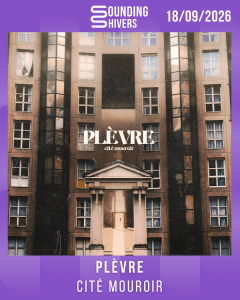
Victor : La pochette est très parlante aussi! Si je ne me trompe pas ce sont les espaces d’Abraxas à Noisy-Le-Grand?
Olivier : Tout à fait exactement! Il y a les Espaces d’Abraxas mais il y a aussi autre chose aussi au milieu. Il y a aussi un petit détail au milieu de la pochette que le public pourra découvrir en regardant bien la pochette.
Victor : Cet ensemble architectural brutaliste a été utilisé par exemple par les films Hunger Games pour les bâtiments du gouvernement. Pourquoi l’avoir choisi pour la pochette du disque?
Olivier : Les Espaces d’Abraxas, le film où ils m’ont le plus marqué personnellement, c’était Brazil de Terry Gilliam. J’ai pas vu les Hunger Games en l’occurrence. Et en fait, pour moi, le bâtiment il a une symbolique assez énorme dans le fait que il y a quelqu’un qui a eu cette idée, un architecte qui a eu cette idée dans sa tête d’un espace complètement délirant, vraiment gigantesque. Quand on y va en personne, on s’en rend encore plus compte à quel point c’est gigantesque, et maintenant il y a des gens qui vivent pour de vrai. Et ils sont vraiment dans quelque chose qui est utilisé par des films qui représentent des dystopies. Par exemple, dans les paroles de « A Corps Perdu », il y a un vers où c’est « asservi par le poids de ces amas de béton », je pense que quand on passe dans Abraxas, on se sent vraiment écrasé par ce qui est autour de nous. Et le fait que ce soit juste un peu le fantasme d’un mec il y a 70 ans qui a voulu designer et construire un bâtiment pareil, je trouve que le concept lui-même est intégral à notre direction artistique. C’est clairement le bâtiment le plus Plèvre qui existe les Espaces d’Abraxas.
Ophélie : Oui, c’est ça, et comme le disait Olivier des gens y vivent et pas forcément dans les meilleures conditions non plus quoi. Donc oui c’est clairement très Plèvre!
Victor : Au moment où on se parle vous avez deux morceaux déjà disponibles, « Asbestose » et « A Corps Perdu ». Quels retours avez vous eu depuis la sortie de ces morceaux, sachant que ce sont les toutes premières sorties du groupe?
Ophélie : Bah franchement, on a eu des retours super chouettes, que ce soit du coup nos premiers live, puisque on a fait aussi nos premières dates avant l’été, et franchement, on était très contents de voir que les morceaux prenaient bien aussi en live, qu’ils avaient une bonne énergie et qu’on avait plein de retours très chouettes des personnes qui sont venues nous voir jouer. Et sur la sortie des morceaux, donc « Asbestose » en juillet, qui a été accompagnée d’un clip, on a eu de supers retours aussi bien sur le clip que sur le titre. Et « A Corps Perdu », les retours ont été encore plus chouettes. Donc, ça fait vraiment plaisir de donner à écouter nos morceaux et que des personnes s’y retrouvent et les aiment comme nous on les aime. Donc voilà, c’est très chouette.
Olivier : J’ai vu un des morceaux dans la story de quelqu’un que je ne connaissais pas du tout, non, dans un poste de quelqu’un que je connaissais pas du tout récemment. J’ai l’impression que c’est quand même deux sorties qui pour l’instant résonnent pas mal en dehors de nos cercles habituels et en dehors de notre audience habituelle aussi. Parce que bon, la musique que l’on a pu faire avant était vraiment destinée à un public particulier, et là on sort de ça. Et en tout cas, on a hâte de montrer l’intégralité de Cité Mouroir aux gens parce qu’on en est très fières.
Victor : Est-ce que vous avez déjà des projets après justement ces dates d’été, de remonter sur scène pour présenter l’album quand il sera sorti?
Ophélie : Ouais! On a qu’une hâte, c’est de c’est de remonter sur scène pour présenter l’album, le défendre en live. Donc voilà, là, on a pas de date à te communiquer tout de suite, mais on espère avoir quelques opportunités confirmées très bientôt.
Victor : En tout cas, de notre enfin de mon côté, j’espère vous voir à Lille très vite parce que j’ai adoré l’album.
Ophélie : Ça sera un grand plaisir de venir à Lille pour jouer.
Olivier : C’est un endroit où on avait prévu de jouer dans tous les cas.
Victor : Dernièrement dans le l’univers un peu black métal et post black métal, il y a pas mal de groupes qui commencent à bien sortir de leurs régions respectives, je pense à des groupes comme Galibot, Houle ou encore MürrMürr. Comment vous voyez cet intérêt renouvelé pour une scène en pleine expansion de l’intérieur?
Olivier : Je pense qu’il y a beaucoup de groupes actuellement qui peut-être inconsciemment ou en suivant la trace d’autres groupes qui étaient pas nécessairement français vont vers ce genre musical. J’ai quand même l’impression que récemment il y a eu pas mal de groupes en dehors de la France qui ont un peu été les pionniers d’un style de black métal plus accessible, plus mélodique, plus accrocheur peut-être. Je pense à Uada qui sont américains…
Ophélie : Kanonenfieber aussi?
Olivier : Oui, carrément Kanonenfieber, je pense aussi à des groupes comme Groza ou Grima. Il y a eu plein de groupes comme ça qui ont été un peu les pionniers, on va dire, d’un type de black métal qui s’émancipe un peu de certains codes qui ont été vraiment ancrés dans le genre, entre guillemets, traditionnel. Et je pense que c’est quelque chose qui s’est beaucoup exporté chez nous et qu’il y a beaucoup de gens qui ont écouté ça ces dix dernières années et que ça ressort juste. Comme c’est devenu des inspirations pour pas mal de gens, c’est en train de ressortir un peu dans les nouveaux projets actuels. Et je pense que c’est quelque chose qui ne nous a pas épargné non plus. J’ai écouté beaucoup de ces groupes là ces dernières années et c’est fatalement ça ressort.
Ophélie : Mais en tout cas, c’est chouette aussi que la scène française prenne du galon. et qu’elle puisse justement commencer, elle aussi, à s’exporter. C’est cool d’avoir une scène Française bien active!
Olivier : Surtout avec un métal qui est un peu délaissé par les auditeurs français. Enfin, quand on parle des plus gros groupes de métal français actuellement; ils remplissent beaucoup plus de stades dans d’autres pays que en France. quoi. C’est cool quand même qu’on ait qu’on ait des choses qui marchent un peu en France.
Ophélie : Tout à fait!
Victor : J’ai vu sur un de vos posts Cafard, la chanteuse de Houle, qui vous a mis un petit mot. Je me suis dit que ça faisait un beau lien avec ce groupe que nous, on aime beaucoup.
Olivier : Nous aussi, on les aime beaucoup. Certains plus que d’autres (rires).
Victor : Ce sera répété! (rires)
Olivier : C’est pas vrai, c’est pas vrai on les adore tous!
Victor : Pour terminer, on voulait vous demander quels sont les artistes qui vous ont donné ces fameux frissons ces derniers mois?
Ophélie : Je pense que mon obsession 2026, je pense que c’est Black Bile avec leur album L’Oratoire qui est qui est juste magnifique. Vraiment énorme coup de cœur! Sinon, j’ai Witch Club Satan aussi que j’aime beaucoup, et notamment sur leur live que j’ai eu l’occasion de voir au Brutal Assault début août. Et vraiment, en termes de scéno, de messages, d’incarnation, d’énergie, de puissance, c’est vraiment une grosse claque! Ouais, je pense que il y a ces deux-là et après il y en a plein d’autres en réalité. Je pense que j’ai aussi beaucoup aimé l’album de Aliore, qui est qui est un groupe niçois, qui a aussi beaucoup tourné dans ma playlist.
Olivier : Ouais, moi ça va être le florilège parce qu’en ce moment je découvre pas mal de trucs. Notamment des groupes qui ont rien sorti depuis 10 ans, mais je les adore quand même. Je me suis mis à écouter du Loathe beaucoup récemment, notemment l’album I Let It In And It Took Everything, qui est déjà un peu vieux. J’écoute aussi un groupe de hardcore de qui s’appelle Cult Leader, qui est incroyable, que je conseille fortement. Sinon, un groupe un peu inclassable qui est le projet plus ou moins solo d’un mec qui s’appelle Lyle Cooper, qui a joué avec The Faceless, qui s’appelle Mithridatum. L’album Harrowing est très intéressant, très dissonant, très progressif, avec beaucoup de signatures rythmiques bizarres. Et récemment, j’ai aussi beaucoup saigné Peeling Flesh et Sanguisugabogg , le dernier que j’ai vu d’ailleurs en concert. Du slam brutal death, très débile avec beaucoup de beaucoup de breakdown. Il n’y a pas grand chose d’intelligent là-dedans, mais j’adore. Et sinon, bah le je dirais que pour moi, et là c’est même pas une révélation, c’est juste une obsession de longue date. C’est le dernier album de Der Weg Einer Freiheit, que j’ai pu voir en live également, et qui continuent de rehausser la barre d’album en album depuis peut-être dix ans maintenant. Enfin, même leurs premiers, ils étaient dingues. Mais là, vraiment, je crois que c’est le groupe dont on se rappellera dans quinze, vingt voir trente ans. Vraiment Der Weg Einer Freiheit, peut-être top 5 de mes groupes préférés de tous les temps.
Ophélie : C’est vraiment ma deuxième obsession aussi. Enfin, je les ai toujours un peu un peu en fond et j’ai adoré leur dernier album. Je viens de les voir cinq ou six fois, je le compte plus et à chaque fois ça vaut le coup. Clairement, c’est pas pour rien qu’on les a cités aussi dans nos dans nos communications.
Victor : Merci à vous pour vos réponses et bravo pour ce superbe album!
Ophélie : Merci à toi! Tu es la toute première interview du projet, donc merci!
Olivier: Merci beaucoup !
Un grand merci à Eddy et Frozen Records pour l’opportunité, à Ophélie et Olivier pour leur disponibilité et leurs réponses et à Plèvre pour l’album !
To mark the release of their very first album, Cité Mouroir, on Frozen Records, we had the chance to ask Ophélie G. and Olivier M., the singer and drummer, respectively, of the band Plèvre, a few questions. Their post-black metal, infused with a variety of influences, struck us with its power, and we wanted to find out more about this young band, the making of the album, their visual aesthetic and, of course, the music that moves them.
Cover photo : Elisabeth Udov
Victor: I wanted to start by asking you about the origins of Plèvre, which is a fairly new band. How did you come to form this band? Where did the desire to make music together come from?
Ophélie: There are four of us in the band. So, Olivier, who’s here with us, plays the drums and lead guitar, and also writes the songs; Paul plays guitar; another Olivier plays the bass; and then there’s me. We’ve been making music together for a few years now, quite a few years for some of us, in fact. We had a previous project which sort of came to a natural end, and we really decided to start again from scratch and move towards something that suited us better. And we created Plèvre, something more grounded in reality that helps to channel what we had in our heads and in our hearts, if you can put it that way, with a different vibe, with different elements.
Olivier: Not with all the original members, of course, some of them have moved on to other ventures. If I might add something, I’d say that the two of us, Olivier and Paul, have been playing together for perhaps eight or nine years now. So it’s kind of a given that we’ll stick together. It’s a project where we’ve also changed our approach quite a bit in terms of who writes what, and our live performance style in general. There are loads of things like that which we’ve started from scratch, with a whole new production team behind us.
Victor: You’re releasing a full-length album straight away without putting out any EPs or anything else first. When did you start working on this album and why did you choose the full-length format?
Olivier: Well, actually, I started writing the very first tracks, perhaps in 2023 or 2024. And it was those tracks, in a way, that laid the foundations for the rest of the tracks, which were actually written, for the most part, in a very short space of time. Because there are perhaps four or five tracks on the album that were written in the space of, I don’t know, maybe two months, I’m exaggerating, perhaps four months, so that was sometime in 2024 or 2025, I think. And finally, the album itself was recorded over a year ago now. We recorded it at Studio DNI in June–July 2025. So, ultimately, we didn’t turn up with a finished album. From the very beginning, let’s say it’s something that was built up over quite a while – easily three years, really.
Victor: So yes, it’s the culmination of several years’ work that ultimately led to it becoming an album.
Olivier: I think it’s also something we’ve all wanted to do, to release an album. We’ve all put out loads of EPs in previous projects, and the idea of doing something a bit longer – where we’ve got time to explore a range of different sounds and establish the band’s stylistic foundation, was something that appealed to us a bit more than just releasing four tracks to make our presence felt. Mind you, I’ve got nothing against EPs, I listen to loads of them. But in this case, we really wanted to put out something quite substantial right from the start.
Victor: The album is massive, both in terms of its cover art and its sound, and evokes equally imposing images, such as large housing estates or asbestos and its impact on human health in ‘Asbestose’. What were your thematic intentions when creating these tracks? There’s a distinct sense of a move towards something brutalist…
Ophélie: Regarding the themes of Plèvre, whether it’s the name or the tracks themselves, you’ve put it very well: they revolve somewhat around subjects such as contamination, with asbestos as a backdrop and the slightly oppressive, shall we say, nature of concrete, and so on. It’s something that inspired us greatly. I think we talked about brutalism quite early on when thinking about the project and its imagery, but also the lyrics. As for the lyrics, ultimately, we tried – and indeed in our art direction more generally, to draw a sort of parallel between our image of the late 1970s, with the construction of all those rather distinctive housing estates, and also an era that, in our view, resonates, at least to some extent, with lost illusions and dashed hopes. And which, in fact, seems to us to draw a fairly good parallel with what we might be experiencing today and what perhaps our generation is currently going through. And so, at least for me, it’s a huge inspiration when writing to be able to channel a bit of everything I don’t understand about society and all the anxiety and fear that it can trigger, and consequently, yeah, to draw those parallels throughout the whole project and the world we’re creating.
Victor: Listening to the album, and as mentioned in the promotional material, your sound is very much black metal, but you can immediately sense that there are other influences at play. Do these influences stem from your past projects that you were talking about earlier? For example, Ophélie’s clean vocals on several of the tracks clearly stray from the typical post-black metal sound.
Olivier: It’s a bit of a conscious choice we made with the album. Right from the start, right from the composition stage, even without the vocals, there were lots of elements that drew on hardcore, for example. There are actually quite a few breakdowns in the tracks. I’m thinking of “Sillons Sanglants”, which closes the album, and to some extent “Asbestose”, which has a riff that’s a bit primal, a bit hardcore. We didn’t really set out consciously to incorporate all that. It’s just that, for example, I listen just as much to bands like Brutus, who are talked about a lot, who are pure hardcore punk with clean vocals, just as I’ve listened to a lot of First Fragment and Beyond Creation, who are pure and simple tech death, very melodic. And ultimately, the sound of the album was shaped by all of that. On top of that, Ophélie sings in a clean vocal style because we love clean vocals in general. And personally, I really like Ophélie’s clean vocals. And we also aim to include some tracks with hooks. We’ve tried to make the choruses a bit catchy at times, which is new for us, because before we didn’t make catchy music at all. So there you have it, there are indeed lots of different influences that have gone into the album. There are plenty of elements that stray a bit from the pure post-black style. It’s really something we worked on throughout the composition of the album
Victor: The cover art is very evocative too! If I’m not mistaken, that’s the Espaces d’Abraxas in Noisy-le-Grand?
Olivier: Absolutely spot on! It’s the Espaces d’Abraxas, but there’s something else in the middle as well. There’s also a small detail in the centre of the cover that fans will be able to spot if they look closely.
Victor: This brutalist architectural complex was used, for example, in the Hunger Games films to depict government buildings. Why did you choose it for the album cover?
Olivier: As for Les Espaces d’Abraxas, the film that made the biggest personal impression on me was Terry Gilliam’s Brazil. I haven’t actually seen The Hunger Games. And actually, for me, the building has quite enormous symbolic significance in the fact that someone came up with this idea, an architect who conceived this completely outlandish, truly gigantic space in his mind. When you go there in person, you realise even more just how gigantic it is, and now there are people actually living there. And they’re literally in a setting that’s used in films depicting dystopias. For example, in the lyrics to ‘A Corps Perdu’, there’s a line that goes : « asservi par le poids de ces amas de béton » (‘enslaved by the weight of these concrete masses’); I think that when you walk through Abraxas, you really feel overwhelmed by your surroundings. And the fact that it’s just a bit of a fantasy from a bloke 70 years ago who wanted to design and build a building like that, I think the concept itself is integral to our artistic direction. The Espaces d’Abraxas is clearly the most Plèvre building there is.
Ophélie: Yes, that’s right, and as Olivier said, people live there, and not necessarily in the best conditions either. So yes, it’s definitely very Plèvre!
Victor: As we speak, you’ve already got two tracks out, “Asbestose” and “A Corps Perdu”. What sort of feedback have you had since these tracks were released, bearing in mind that they’re the band’s very first releases?
Ophélie: Well, to be honest, we’ve had some really great feedback, both from our first live gigs, as we played our first gigs before the summer, and, frankly, we were really pleased to see that the tracks went down well live too, that they had good energy, and that we got loads of really great feedback from the people who came to see us play. And regarding the release of the tracks, ‘Asbestose’ in July, which was accompanied by a music video, we got brilliant feedback on both the video and the track itself. And for ‘A Corps Perdu’, the feedback was even better. So, it’s really lovely to share our tracks and for people to relate to them and love them as much as we do. So there you go, it’s brilliant.
Olivier: I saw one of the tracks in a story posted by someone I didn’t know at all – no, in a post by someone I didn’t know at all,quite recently. I get the impression that these two releases are actually making quite a splash outside our usual circles and beyond our usual audience as well. Because, well, the music we’ve made before was really aimed at a specific audience, and now we’re moving away from that. And in any case, we can’t wait to show people the whole of Cité Mouroir because we’re very proud of it.
Victor: Do you already have any plans after these summer dates to get back on stage and present the album once it’s been released?
Ophélie: Yeah! We can’t wait to get back on stage to present the album and perform it live. So, we don’t have any dates to share with you just yet, but we hope to have a few confirmed opportunities very soon.
Victor: In any case, speaking for myself at least, I hope to see you in Lille very soon because I absolutely loved the album.
Ophélie: It’ll be a real pleasure to come and play in Lille.
Olivier: It’s a place we’d planned to play anyway.
Victor: Lately, in the black metal and post-black metal scene, there are quite a few bands starting to make a name for themselves beyond their respective regions, I’m thinking of bands like Galibot, Houle and MürrMürr for example. How do you view this renewed interest in a rapidly expanding scene from the inside?
Olivier: I think there are a lot of bands at the moment who, perhaps unconsciously or by following in the footsteps of other bands that weren’t necessarily French, are gravitating towards this musical genre. I do get the impression, though, that recently there have been quite a few bands outside France who have, in a way, pioneered a more accessible, more melodic and perhaps more catchy style of black metal. I’m thinking of Uada, who are American…
Ophélie: Kanonenfieber too?
Olivier: Yes, definitely Kanonenfieber, I’m also thinking of bands like Groza or Grima. There were loads of bands like that who were, shall we say, pioneers of a type of black metal that broke free a bit from certain conventions that were really ingrained in the so-called ‘traditional’ genre. And I think that’s something that’s had a big influence over here, and that loads of people have been listening to that sort of thing over the last ten years, so it’s just coming to the fore. As it’s become a source of inspiration for quite a few people, it’s starting to show up a bit in the new projects coming out now. And I think it’s something that hasn’t left us unscathed either. I’ve listened to a lot of those bands over the last few years, and inevitably that comes through.
Ophélie: But in any case, it’s great too that the French scene is gaining prominence and that it, too, can start to make its mark abroad. It’s cool to have such a vibrant French scene!
Olivier: Especially with metal, which is somewhat neglected by French listeners. I mean, when you look at the biggest French metal bands at the moment, they fill far more stadiums in other countries than in France. Still, it’s cool that we’ve got some acts that are doing quite well in France.
Ophélie: Absolutely
Victor: I saw in one of your posts that Cafard, the singer from Houle, had left you a little message. I thought it was a lovely connection with that band, which we really like.
Olivier: We like them a lot too. Some more than others (laughs).
Victor: It will be repeated! (laughs)
Olivier: That’s not true, that’s not true, we love them all!
Victor: To finish up, we wanted to ask you which artists have given you those famous goosebumps over the last few months?
Ophélie: I think my obsession for 2026 is Black Bile with their album L’Oratoire, which is just magnificent. I’ve absolutely fallen in love with it! Other than that, I’ve also got Witch Club Satan, who I really like, especially their live set, which I had the chance to see at Brutal Assault in early August. And honestly, in terms of stage presence, messages, performance, energy and power, it’s a real knockout! Yeah, I reckon there are those two, and then there are loads of others, actually. I think I also really liked the album by Aliore, they’re a band from Nice, which has been on heavy rotation in my playlist too.
Olivier: Yeah, mine’s going to be a bit of a mixed bag because I’m discovering quite a lot of stuff at the moment. Especially bands that haven’t released anything for 10 years, but I still love them. I’ve started listening to a lot of Loathe recently, particularly the album I Let It In And It Took Everything, which is already a bit old. I’m also listening to a hardcore band called Cult Leader, who are incredible,I’d highly recommend them. Otherwise, there’s a band that’s a bit hard to categorise: it’s more or less a solo project by a bloke called Lyle Cooper, who used to play with The Faceless, called Mithridatum. Their album Harrowing is really interesting – very dissonant, very progressive, with loads of weird time signatures. And recently, I’ve also been listening to Peeling Flesh and Sanguisugabogg a lot, I actually saw the latter live recently. It’s brutal death slam, absolutely bonkers with loads and loads of breakdowns. There’s not much intelligence to it, but I love it. Otherwise, well, I’d say that for me, and this isn’t even a revelation, it’s just a long-standing obsession, it’s the latest album by Der Weg Einer Freiheit, whom I’ve also seen live, and who’ve continued to raise the bar with every album for perhaps ten years now. Even their early albums were brilliant. But seriously, I reckon this is the band people will still be talking about in fifteen, twenty or even thirty years’ time. Honestly, Der Weg Einer Freiheit are probably in my top five bands.
Ophélie: They’re definitely my second obsession as well. I mean, they’ve always been in the back of my mind a bit, and I loved their latest album. I’ve just seen them five or six times, I’ve lost count, and it’s always worth it. Clearly, there’s a good reason why we’ve mentioned them in our communications too.
Victor: Thank you for your answers and well done on this superb album!
Ophélie: Thank you! You’re the very first person we’ve interviewed for the project, so thank you!
Olivier: Thank you very much!
A lire aussi / Also to be read:
 Sounding Shivers