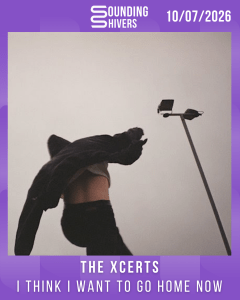
A l’occasion de la sortie de i think i want to go home now, j’ai pu discuter avec Murray Macleod, chanteur et guitariste du groupe The Xcerts. Le musicien de Brighton nous dit tout sur la création de ce sixième album, sur sa vision de l’album précédent ainsi que sur des sujets aussi variés que : les émotions dans les chansons, son amitié avec Sam Carter, la dureté de la vie et son impact dans la musique du groupe….
par Victor Brunerie
Crédit photo : Luke Bovill
English version below
Victor : Vous vous apprêtez à sortir votre sixième album. Mais avant d’aborder ce sujet, cela fait trois ans que votre dernier album est sorti. Quel regard portes tu dessus aujourd’hui ?
Murray : Oui, je suis toujours extrêmement fier de cet album. Nous l’avons enregistré pendant une période assez difficile, car nous sortions tout juste de la pandémie de COVID et du confinement. Je pense que nous avions simplement envie de nous amuser et de créer en studio. Et c’était la première fois que nous réalisions un album exclusivement sur un ordinateur portable, en fait. On a donc en quelque sorte expérimenté à notre manière. Beaucoup de gens étaient sceptiques. Et cela a suscité une légère polémique parmi nos fans. Mais j’ai désormais une sorte de recul sur tout ça, et je comprends que cela a peut-être donné l’impression qu’on avait fait un pas de côté, ou qu’on avait pris nos auditeurs au dépourvu. Mais bon, c’est une bonne chose. On a fait le point sur ce qu’on avait fait sur cet album, parce qu’on s’était vraiment lancés dans tout ce qui nous mettait mal à l’aise. Alors que sur ce nouvel album, on s’est lancés dans tout ce qui nous semblait confortable. J’ai donc beaucoup appris de ce processus.
Victor : Et c’est sur cet album que tu as enregistré un morceau avec ton meilleur ami, Sam Carter d’Architects ? Comment as tu vécu le fait d’enregistrer enfin une chanson avec un homme avec qui tu es ami depuis des lustres ?
Murray : C’est vraiment magnifique ! C’était une très belle initiative. Ça faisait des années qu’on en parlait. Je participe à un morceau d’Architects intitulé « Youth Is Wasted on the Young», tiré de l’album Lost Forever // Lost Together. Et oui, Sam n’arrêtait pas de me rabâcher que c’était à son tour de chanter sur l’un de nos albums, mais j’avais l’impression de ne pas avoir écrit la chanson qui lui convenait vraiment. Et je ne voulais pas que Sam se contente de hurler sur une chanson. Il a déjà fait plein de collaborations où il scream. Je voulais mettre en valeur sa voix, qui est vraiment fantastique et magnifique. Du coup, on a écrit « Ache » et je me suis dit : « C’est la chanson parfaite pour Sam. » Ouais, je suis toujours extrêmement fier de cette chanson, et encore plus d’avoir pu la partager avec mon meilleur ami.
Victor : C’est drôle parce que j’étais au concert d’Architects à Alexandra Palace à Londres et je me souviens très bien que tu as couru vers l’avant de la fosse pour serrer Sam dans tes bras et qu’il a sauté de la scène quand il t’a vu.
Murray : Ouais, c’est vrai. J’ai surfé sur la foule, Sam m’a repéré, il a sauté de la scène et on s’est fait un énorme câlin. Il y a une vidéo de ce moment qu’il a mise en ligne, et qui a été vue environ un demi-million de fois. Mais je ne m’étais pas rendu compte qu’on me filmait, et j’avais en fait bu beaucoup de tequila ce soir-là. Donc on me voit juste en train de hurler dans ses bras. Mais c’était un moment très authentique. Je suis donc fier de ça.
Victor : En écoutant votre nouvel album, i think i want to go home now. Comment la création de cet album a-t-elle commencé ? À quel moment vous êtes-vous dit « il faut qu’on travaille sur un nouveau projet » et comment la réflexion autour de ce nouvel album a-t-elle démarré ?
Murray : Je dirais qu’on a commencé à parler de l’idée de faire un nouvel album à peu près à mi-parcours de la tournée de Learning How to Live and Let Go. On a écrit quelques chansons, mais on discutait encore de la direction qu’on voulait donner à l’album et du thème qu’il allait aborder. Parce que sur le thème de Learning How to Live and Let Go, je n’ai pas trouvé beaucoup d’inspiration pendant le confinement. J’essayais donc simplement, de mon mieux, de puiser des récits et des histoires à chanter. Et sur cet album, on essayait encore, je suppose, de déterminer comment on allait présenter ce nouvel opus. Et puis la vie a suivi son cours et nous avons vécu des événements assez tragiques. Mon père a appris qu’il avait un cancer. Puis la mère de Jordan a appris qu’elle avait un cancer. Et pendant tout ce temps-là, ma relation avec mon partenaire s’est détériorée. Tout naturellement, le son est devenu beaucoup plus brut, et il y avait beaucoup plus de colère et de souffrance. Et nous devions refléter cela dans la musique. Il fallait donc que ce soit un peu plus hérissé et anguleux. Et nous avons écrit trois chansons d’affilée : « Do It to Myself », « Wow » et « Losing It ». Et ce sont ces moments-là qui ont été des véritables révélations : on a compris où on voulait emmener l’album et quel son on voulait lui donner. Il s’agissait avant tout de le rendre aussi naturel et humain que possible, à nous trois dans une pièce, en faisant simplement beaucoup de bruit et, au niveau des paroles, en laissant jaillir nos émotions.
Victor : J’allais justement dire que ça parle vraiment de chagrin, de perte, de maladie et de tout ça, mais ça fait le lien avec votre premier album, qui n’a pas été réalisé dans le même état d’esprit, mais à une période où les choses étaient difficiles pour vous. Que pensez-vous de ce lien entre ces deux albums ?
Murray : Ouais, franchement, mec, je trouve ça assez inquiétant, en toute honnêteté. Il y a beaucoup de parallèles et de similitudes par rapport à ce qu’on traversait. Jordan a perdu son père pendant qu’on enregistrait cet album. Et puis, sur celui-ci, il a perdu sa mère. C’est donc un peu flippant. Et, malheureusement, la vie peut vraiment être cruelle. Et pire encore, malheureusement, cela est arrivé deux fois à Jordan alors qu’il continuait à créer avec le groupe. Ça donne donc un côté un peu surréaliste. C’est le genre de chose à laquelle je… à laquelle on ne veut pas trop penser. Sinon, je pense qu’on serait complètement paniqués, mais c’est un peu comme si la vie se répétait. Et c’est une expérience horrible pour Jordan. Mais au moins cette fois-ci, nous sommes bien plus mûrs qu’à l’époque où nous étions adolescents, évidemment. Et, tu sais, nous avons un réseau de soutien incroyable parmi nos amis là où nous vivons. Et nous nous sommes vraiment soudés et avons puisé dans l’amour. Alors qu’avant, quand nous étions adolescents, tout cela était un peu trop déroutant pour que nous puissions l’assimiler à ce moment-là. Du coup, on n’a peut-être pas géré ça de la manière la plus saine qui soit. Mais cette fois-ci, on était bien plus déterminés et conscients de la situation.
Victor : J’allais justement te poser la question, parce que sur beaucoup de vos albums, et encore plus sur celui-ci, tu as réussi à écrire des chansons entraînantes et sur lesquelles on peut danser, en gros, tout en abordant des thèmes assez sombres et tristes. Que penses-tu de cet équilibre entre le fait de faire une chanson rock et d’aborder des sujets lourds ?
Murray : J’aime les contrastes en musique. Certains de mes artistes et albums préférés font justement ça. Je pense souvent à quelqu’un comme… Je suis un grand fan de Bruce Springsteen. Il a un album intitulé The Rising (2002) qui, tu sais, quand on l’écoute, donne l’impression que beaucoup de chansons sont joyeuses et optimistes, mais en réalité, quand on se penche sur les paroles, elles sont plutôt sombres et lourdes. Et j’aime l’idée que l’auditeur ressente une certaine confusion dans la chanson. C’est comme, tu sais, comme tu l’as dit, il y a des morceaux sur cet album sur lesquels on peut bouger ou danser. Et j’aime l’idée que les gens se mettent immédiatement à headbanguer ou à bouger leur corps, mais qu’ils entendent peut-être une phrase en particulier et s’arrêtent un instant. Puis ils lisent les paroles et peuvent alors aller plus loin. J’aime bien que les chansons aient plusieurs niveaux de lecture comme ça. Et il y a un album d’un groupe qui s’appelle Saves the Day. Il s’agit de l’album Stay What You Are (2001), qui est l’exemple le plus fantastique de ce dont je parle. Les morceaux ont un son tellement estival et ensoleillé, mais dès qu’on commence à lire les paroles, on se rend compte que c’est en fait un univers profondément sombre. Et oui, j’aime cette sensation d’en découvrir d’avantage en écoutant la chanson.
Victor : Tu vis à Brighton, mais tu es originaire d’Aberdeen. Quelles sont les différences et les similitudes entre ces deux villes ? Et que ressens-tu à l’idée d’être chez toi dans ces deux villes, alors que l’album est intitulé i think i want to go home now ?
Murray : Eh bien, Brighton et Aberdeen ont sans aucun doute des similitudes. Aberdeen est connue comme la « ville de granit ». Tout y est en granit, tous les bâtiments sont construits en granit. C’est donc une ville très grise et morne. Et Brighton peut être très similaire. Et, tu sais, les deux villes sont au bord de l’eau. Donc oui, on peut ressentir une ambiance assez gothique dans les deux villes quand le brouillard monte de la mer. Elles ne sont pas très différentes en taille non plus. Et oui, l’idée de me sentir chez moi dans les deux… Je veux dire, Aberdeen, j’ai un lien intrinsèque avec Aberdeen. J’ai en quelque sorte cette ville dans le sang. Et chaque fois que je suis chez moi, je me sens vraiment en paix. Et, tu sais, je connais cette ville comme ma poche. À Brighton, ce n’est pas tout à fait pareil, je n’ai pas vraiment ce lien affectif avec cette ville. J’aime beaucoup vivre ici. J’ai un super réseau d’amis que je considère comme ma famille ici, ce qui me fait en quelque sorte aimer encore plus cet endroit. Mais oui, j’en suis à un stade où j’ai une relation un peu amour-haine avec Brighton. C’est une ville vraiment, vraiment cool, idéale pour les artistes et les créatifs, car elle les soutient beaucoup, alors qu’Aberdeen ne les soutient pas autant. Tu sais, on est en quelque sorte poussé dès le plus jeune âge à suivre des parcours très traditionnels en matière de travail, de carrière et tout ça. Donc oui, il y a clairement des avantages et des inconvénients dans les deux cas, mais Aberdeen est et restera toujours ma ville natale.
Victor : En parlant des concerts du groupe, quand vous avez joué en France, c’était la plupart du temps avec d’autres groupes, par exemple en première partie de Biffy Clyro ou de You Me At Six. Et puis vous avez été tête d’affiche du Supersonic en 2024. Que penses-tu de vos passages en Europe et prévoyez-vous de faire davantage de tournées en tête d’affiche ?
Murray : On adore jouer en Europe. On adore ça, vraiment. Et on adore particulièrement jouer à Paris. Je pense que ça a toujours été un rêve de jouer dans un endroit comme Paris. Et puis, quand on a commencé à le faire, on s’est dit : « Mon Dieu ! ». Honnêtement, on n’arrivait pas à croire qu’on avait la chance de jouer en France. Et puis, on a été tête d’affiche du Supersonic, ce qui a été un concert incroyable. C’était le dernier jour d’une très longue tournée. Et c’était assez surréaliste d’être si loin de chez nous et de recevoir une telle réaction du public. On avait l’impression que tout le travail acharné fourni lors des concerts en première partie avait porté ses fruits. Donc oui, on prévoit vraiment de revenir l’année prochaine, très probablement pour une tournée en tête d’affiche. Je pense que cette tournée en tête d’affiche qu’on a faite était peut-être un peu trop longue. On est peut-être allés dans des endroits qui n’étaient pas encore tout à fait prêts pour nous. Et oui, ça a été assez éprouvant. Mais beaucoup de concerts de cette tournée ont été géniaux et nous ont vraiment ouvert les yeux sur le fait qu’on a un public là-bas. Alors oui, on a vraiment, vraiment hâte d’y retourner. Et on adorerait aussi avoir l’occasion de faire davantage de tournées en France. Parce qu’on n’a en fait joué qu’à Paris et peut-être dans une autre ville, tout au plus. Mais en général, c’est Paris. On aimerait donc voyager davantage à travers la France, c’est certain.
Victor : J’ai vu que pour la sortie de l’album, vous organisiez une série de concerts et de séances de dédicaces dans des disquaires en Angleterre. Que penses-tu de ces petits événements où vous devez rencontrer les fans, parler de votre musique et jouer dans un cadre différent de celui d’une salle de concert ?
Murray : C’est vraiment génial d’être dans des cadres aussi intimes et de parler en face à face avec les gens qui soutiennent activement le groupe. C’est vraiment très agréable, et c’est sympa d’entendre comment ils perçoivent l’album et ce qu’il signifie pour eux. C’est vraiment l’un des avantages de sortir de la musique : pouvoir écouter les histoires de ceux qui la vivent au quotidien. J’ai donc vraiment hâte d’y être. Ça peut parfois être un peu gênant, parce qu’on donne un concert de rock avec tout le groupe dans un magasin de disques. Et cet environnement peut, bizarrement, sembler assez déconcertant. Je n’arrive pas vraiment à l’expliquer. C’est un peu comme si le public ne savait pas trop comment se comporter, de peur de renverser les disques exposés sur les étals et tout ça. Mais oui, ça devrait être vraiment bien. Tout est mis en œuvre pour que ce soit génial. J’ai donc hâte de donner vie à ces chansons et de les interpréter devant les fans du groupe.
Victor : D’ailleurs, vous allez jouer au festival 2000 Trees dans quelques jours. Que penses-tu de ces festivals un peu plus modestes ? Ils ne sont pas comme ces grands festivals qui accueillent une centaine de groupes. Que penses-tu de ces formats plus intimes et de ces festivals qui mettent en avant des artistes moins connus ?
Murray : Pour être honnête, j’adore jouer dans les petits festivals. Je pense que lors de ces festivals, il y a certes des têtes d’affiche, mais je trouve ça génial qu’un festival de cette taille mette en avant de nouveaux talents. Et j’ai l’impression que dans les petits festivals, surtout dans un festival comme le 2000 Trees, il n’y a que 20 000 amateurs de musique. Du coup, tu vois, le premier groupe qui monte sur scène à midi va attirer une foule immense, parce que les gens ont vraiment envie de découvrir de la nouvelle musique. Et ce genre de festivals encourage les festivaliers à découvrir de la nouvelle musique. Et je trouve ça formidable. Parfois, dans les grands festivals, les petits groupes peuvent se faire un peu écraser par l’immensité du cadre et par la liste des artistes présents. Tu sais, dans les grands festivals, à tout moment, il peut y avoir un groupe très, très confirmé qui joue, ce qui enlève peut-être un peu l’intérêt de découvrir de nouvelles musiques, ce que ces petits festivals parviennent plutôt bien à faire. C’est vraiment, vraiment génial. Et personnellement, j’adore jouer dans des petits festivals. On y ressent aussi un peu moins d’anxiété. Dans les grands festivals, l’ambiance peut parfois être un peu paniquée et chaotique : on monte sur scène, on en redescend… C’est très intense. Cela ne veut pas dire que le 2000 Trees n’est pas un festival professionnel, bien au contraire. Mais il y a un peu plus de chaleur chez tous ceux qui y travaillent, un peu plus d’esprit communautaire.
Victor : Vous avez sorti six albums avec le groupe à ce jour. Que ressens-tu à l’idée d’avoir mené le groupe aussi loin et d’être aux côtés de Jordan depuis les débuts du groupe ? Que penses-tu de toutes ces années ?
Murray : J’en suis maintenant à un stade où je peux en quelque sorte faire le point, et honnêtement, je me sens tout simplement extrêmement fier de ce que nous avons accompli, même si nous n’avons pas tout à fait atteint les sommets vertigineux dont nous rêvions quand nous étions ados. Mais le fait que nous ayons encore la chance d’enregistrer des albums, de partir en tournée, d’avoir des gens qui s’intéressent au groupe, et que nous ayons réussi à maintenir notre relation pendant 25 ans, c’est assez incroyable. Tu sais, on est une famille, et on peut être une famille dysfonctionnelle ; y ajouter les aspects professionnels ne facilite pas les choses. Donc oui, en ce moment, je ressens une immense fierté envers moi-même et mes meilleurs amis.
Victor : Quels retours avez-vous eus sur les premiers titres sortis avant l’album ?
Murray : C’était génial. Je pense que, comme le dernier album avait été accueilli avec un peu de réticence, on est en quelque sorte revenus à la recherche de ce qui définit le son de notre groupe. Je crois que les gens étaient, d’une part, soulagés et, d’autre part, presque surpris qu’on revienne à notre son caractéristique, et cela n’a suscité que de l’enthousiasme, de l’amour et du soutien. Et ces chansons semblent vraiment avoir touché le public très, très rapidement, peut-être même plus que n’importe lequel de nos autres albums, ce qui est génial parce que nous voulons être à la hauteur des attentes de nos fans. Et, en raison de la nature de cet album, nous l’avons fait de manière très égoïste, juste pour nous trois. On n’avait pas vraiment pensé au fait que d’autres personnes l’écouteraient. Alors recevoir toute cette chaleur et cet amour de la part du public m’a semblé bouleversant. Et les gens semblent d’accord pour dire que c’est peut-être notre meilleur album à ce jour, ce qui est génial parce que c’est ce que nous pensons aussi.
Victor : Comment te sens-tu à l’approche de la sortie de l’album dans les prochains jours ?
Murray : Je pense que j’éprouve des sentiments très mitigés. Ce n’est pas vraiment juste un album pour nous, ça représente bien plus que ça : c’est le reflet de ces deux années vraiment difficiles, et cet album compte énormément pour nous ; c’est véritablement une partie de notre âme et de notre cœur. Pour être honnête, je suis un peu perdu sur le plan émotionnel. J’ai presque du mal à croire que nous ayons réalisé cet album, sans parler du fait que nous allons le sortir et que les gens vont l’écouter. Je suis donc très fier. Je suis presque un peu triste à l’idée que mon petit bébé secret soit bientôt dévoilé au monde entier. Vous voyez, ce genre de sentiment. D’un autre côté, j’ai vraiment hâte que tout le monde puisse écouter l’album. Donc, oui, j’ai beaucoup de sentiments contradictoires, mais globalement, comme je suis très fier de cet album, j’ai hâte que le jour de sa sortie arrive et que les gens puissent le découvrir, s’imprégner de ses morceaux et vivre avec. Et j’espère qu’ils trouveront du réconfort dans la laideur dont je parle dans mes chansons.
Victor : Pour finir, notre média s’appelle Sounding Shivers, et nous aimons demander aux personnes que nous interviewons : quels sont les groupes ou artistes qui, ces derniers mois, t’ont donné ces frissons en les écoutant ?
Murray : Ouh là, j’en ai quelques-uns, en fait. Il y a un artiste qui s’appelle Dijon. Je ne sais pas si tu le connais, c’est un artiste américain. Je suis fan de lui depuis quelques années déjà, mais il a récemment sorti un album intitulé Baby, qui est tout simplement une œuvre assez époustouflante. J’ai encore du mal à saisir tout ce qu’il a réussi à faire au niveau de la production. Il produit tout lui-même. Et oui, en écoutant cet album, on sent qu’il a vraiment repoussé les limites de sa palette sonore ; c’est une expérience assez bouleversante, mais ça m’a vraiment enthousiasmé. Ça m’a semblé à la fois familier et futuriste, donc j’ai vraiment été époustouflé par cet album. L’autre album qui m’a vraiment touché, c’est Heavy Metal de Cameron Winter. C’est le chanteur de Geese, mais il a sorti cet album solo qui me donne presque l’impression d’avoir grandi en l’écoutant, comme si c’était un disque que mes parents m’auraient fait écouter dans les années 70, alors qu’il est sorti, je crois, l’année dernière ou quelque chose comme ça. On a tout de suite l’impression qu’il est intemporel : c’est une écriture magistrale, de magnifiques chansons, des paroles vraiment intéressantes. Et la production est tellement chaleureuse et accueillante. Il y a comme une touche originale dans ce son de composition classique qu’il cherche à créer, où je n’arrivais pas tout à fait à mettre le doigt sur ce à quoi ça ressemble, ce qui, bien souvent, correspond pour moi à la musique qui sonne le mieux.
Victor : La musique qui, quand on l’écoute vraiment, nous fait découvrir de nouvelles choses à chaque fois ?
Murray : Ouais, exactement ça. Et c’est quelque chose qui donne l’impression, je dirais, de se situer dans un espace liminal où l’on se sent à la fois familier et nostalgique, mais où c’est tout de même nouveau. Et ouais, c’est génial quand on tombe sur une musique comme ça, qui est tout de suite si réconfortante. Ce n’est pas facile à faire, mais il y est vraiment parvenu.
Victor : Merci beaucoup et bravo pour l’album, c’est vraiment un plaisir de l’écouter.
Murray : Merci beaucoup
Victor : Encore un grand merci et à bientôt en France ou dans les environs !
Murray : J’ai hâte d’y retourner ! À bientôt !
Un grand merci à Roger, Where The Promo Is et FLG pour cette belle opportunité et à Murray pour sa disponibilité et ses réponses!
To mark the release of i think i want to go home now, I had the chance to chat with Murray Macleod, singer and guitarist with the band The Xcerts. The Brighton-based musician tells us all about the making of this sixth album, his take on the previous album, and a wide range of topics including: the emotions in the songs, his friendship with Sam Carter, the harshness of life and its impact on the band’s music….
Cover photo by : Luke Bovill
Victor : You’re going to release your sixth album. But just before we go on to that, it’s been three years since your last album was out. How did you reflect on it today?
Murray : Yeah, I’m still immensely proud of that record. We made that album during quite a tricky time, because we were coming out of COVID and lockdown. And I think we just wanted to have fun and just kind of create in the studio. And it was the first time that we had made an album solely on a laptop, really. So we were kind of experimenting in our own way. A lot of people weren’t sure of it. And it was met with a slight backlash from our fan base. But I kind of have like a bird’s eye perspective on it now, where I understand that maybe it felt like we took a bit of a step left or something or threw a curveball at our listeners. But yeah, it’s good though. We took stock of what we did on that record because we lent very much into everything that made us feel uncomfortable. Whereas on this new record, we lent into everything that felt comfortable. So I learned a lot from that process.
Victor : And it was on this album that you did a track with your best friend, Sam Carter from Architects? How was it to finally record a song with a man you’ve been friends with for ages?
Murray : Really beautiful! It was a really beautiful thing to do. We had spoken about it for many years. I appear on an Architects song called « Youth Is Wasted on the Young » from Lost Forever // Lost Together. And yeah, Sam was always bugging me that it was his turn to sing on one of our records, but it felt like I hadn’t written the correct song for him to sing on. And I didn’t want Sam to just scream on a song. He’s done a lot of features where he screams. And I wanted to showcase his really fantastic, beautiful voice. So yeah, we wrote « Ache » and I was like, this would be the perfect song for Sam to be on. Yeah, really still immensely proud of that song and even more so that I got my, I got to share that with my best friend.
Victor : It’s funny because I was at the Ally Pally Architects’ gig and I remember you distinctly running at the front to hug Sam and him jumping of stage when he saw you.
Murray : Yeah, that’s right. I crowd surfed and Sam spotted me and he jumped down and we had a huge hug. There was a video taken of that which he put online, which has like half a million views. But I didn’t realize it was being filmed and I’d actually drunk a lot of tequila that night. So it’s just me screaming in his arms. But it was a very real moment. So I’m proud of it.
Victor : Going on your new album, i think i want to go home now. How did the creation of the album started? What was the point when you said « we have to work on the new thing » and how did the reflection on the new album started?
Murray : So I guess we started talking about the idea of making a new record kind of halfway through the touring cycle of learning how to live and let go. And we wrote a few songs, but we were still kind of discussing where we wanted to take the record and what the record would be about. Because on learning how to live and let go, there wasn’t a mass amount of inspiration in lockdown for me. So I was just trying my best to pull narratives and stories to sing about. And on this one, we were still trying to, I guess, process how we were going to present this new one. And then life happened and we had some pretty tragic events happen in our lives. My dad got diagnosed with cancer. Then Jordan‘s mum got diagnosed with cancer. And during all of that, I had the deterioration of my relationship with my partner. So very kind of organically, the sound became a lot more raw and there was a lot more kind of anger and hurt. And we had to reflect that in the music. So it had to be a little more spiky and angular. And we wrote three songs back-to-back, which were do it to myself, wow, and losing it. And those were kind of the light bulb moments where we clocked where we wanted to take the record and what we wanted the record to sound like. And it was very much about making it as organic and as human as possible with the three of us in a room just making a lot of noise and kind of, you know, lyrically an outpouring of emotion.
Victor : I was going to say, it’s really about heartbreaking and loss and sickness and all that, but it links with your first album, which was not made in the same mindset, but was at a period where things got rough for you. How do you feel about that connection between those two albums?
Murray : Yeah, honestly, dude, I find it quite eerie in all honesty. There’s a lot of parallels and a lot of similarities in regards to what we were going through. Jordan lost his father whilst we were making that record. And then on this one, he lost his mother. So it’s kind of spooky. And, unfortunately, life can just be really cruel. And even more, unfortunately, it’s happened to Jordan twice whilst he’s, still been creating with the band. So it feels somewhat surreal. It’s something like I don’t, we don’t want to think about it too much. Otherwise, I think we’ll just be totally freaked out, but kind of life repeating itself. And it’s a horrifying thing for Jordan. But at least this time round, we’re in a place where we’re a lot more mature than when we were teenagers, obviously. And, you know, there’s such an amazing support network of friends where we live. And, we just really bonded together and kind of lent on love. Whereas before, when we were teenagers, it was all just a bit too confusing for us to process at that time. So maybe we didn’t deal with it in the most healthy of manners. But this time round, we were a lot more kind of headstrong and aware.
Victor : I was going to ask, because on many of your albums and even more so this one, you managed to write songs that are catchy and that you can dance to basically, on themes that are quite rough and sad. How do you feel about that balance between like going on a rock song and talking about like heavy stuff?
Murray : I enjoy juxtaposition in music. Some of my favorite artists and records do that very thing. I often think about somebody like, I’m a huge Bruce Springsteen fan. And he has a record called The Rising (2002), which, you know, when you listen to it, a lot of the songs on there sound so joyous and uplifting, but actually once you dig into the lyrical content, they’re pretty morose and heavy lyrically. And I like the idea of the listener being like there being a sense of confusion in song. It’s like, you know, like you said, there’s songs on there that you can move to or like dance to. And I like the idea that people immediately start banging their head or move their bodies, but maybe they’ll hear like a certain line and kind of stop for a second. And then they read the lyrics and then they can dig deeper. I like people I like having layers in songs like that. And there’s a record by a band called Saves the Day. There’s a record called Stay What You Are (2001), which is the most fantastic kind of example of what I’m talking about. The songs sound so summery and so sunny, but once you start reading the lyrics, it’s like, it’s deeply dark stuff. And yeah, I like that feeling of discovering more in song.
Victor : You live in Brighton, but you’re from Aberdeen. What are the difference and similarities between the cities? And how do you feel about being home in those two cities and having named the album i think i want to go home now?
Murray : So Brighton and Aberdeen definitely have similarities. Aberdeen’s known as the granite city. Everything’s, all the buildings are made out of granite. So it’s a very grey, dreary city. And Brighton can be very similar. And, you know, both cities are by the water. So yeah, you can have kind of quite a gothic feel in both cities when the fog comes in from the water. They’re not too dissimilar in size either. And yeah, the idea of being home in both, I mean, Aberdeen, I’m kind of intrinsically linked to Aberdeen. I kind of feel that city in my blood. And whenever I’m home, I feel very much at peace. And, you know, I know that city like the back of my hand. And being in Brighton, it doesn’t quite have that, I don’t quite have that emotional attachment with this city. I really like living here. I’ve got a great network of friends who I call family down here, so that makes me kind of love this place more. But yeah, I’m kind of at a point where I have a bit of a love-hate relationship with Brighton. It’s a very, very cool city and great for artists and creatives to live in because it’s very supporting of that, whereas Aberdeen isn’t so supportive. You know, you’re kind of forced from a young age to go down very traditional routes in terms of work and jobs and stuff. So yeah, there’s definitely pros and cons to both, but Aberdeen is and will forever be my home.
Victor : Talking about the live part of the band, when you played in France, most of the time it was with other bands like opening for Biffy Clyro or You Me At Six for example. And then you headlined Supersonic in 2024. How do you feel about coming to Europe and do you plan on going more on headline tours?
Murray : We absolutely adore playing in Europe. We absolutely love it. And especially we love playing in Paris. I think it was always a dream to play somewhere like Paris. And then when we started doing it, we were like « my God! ». We honestly couldn’t believe that we were afforded the opportunity to play in France. And then, we headlined Supersonic, which was an amazing show. It was the last day of a very long tour. And it was quite surreal being so far from home and having that reaction from the crowd. And it felt like kind of all the hard work playing support shows had paid off. So yeah, we definitely, plan on coming back next year for more than likely like a headline run. I think that headline tour we did was maybe a bit too long. We maybe went to some places that maybe weren’t ready for us. And yeah, it felt quite grueling. But a lot of the shows on that tour were brilliant and quite eye-opening to the fact that we’ve got listeners out there. So yeah, really, really excited to get back. And we would also love the opportunity to actually tour France some more. Because we’ve only ever really played Paris and maybe one other city, maybe. But usually it’s Paris. So we’d like to travel around France some more, definitely.
Victor : I saw that for the album release, you’re doing an in-store run of shows and signings in England. How do you feel about those small events where you have to meet the fans and talk about your music and play in a different setting than in a live venue?
Murray : It’s very cool to be in such intimate settings and speak to the people face to face who are actively supporting the band. It’s a really lovely thing and it’s nice to hear about how they’re digesting the record and what it means to them. That’s a real pro of getting to release music to hear other people’s stories who have been living with it. So really excited to do that. They sometimes can be a little awkward because you’re playing like a full band rock show in a record store. And that environment can weirdly feel quite jarring. I can’t quite explain it. So it’s almost like the audience doesn’t quite know how to act because they’re worried about knocking over records that are out in stalls and stuff. But yeah, it should be really good. They’re gearing up to be great. So I’m just looking forward to actually bringing these songs to life and performing them for the people who are fans of the band.
Victor : Also, you’re playing 2000 trees in some days. How do you feel about those maybe smaller festivals? They’re not like the huge ones with 100 or so bands. How do you feel about those smaller settings and those festivals who put smaller artists forward?
Murray :I love playing the smaller festivals, truth be told. I think at these festivals, they do have larger acts playing, but I think it’s great for a festival of that size to showcase new talent. And I feel like at the smaller festivals, especially something like 2000 Trees, it’s just 20,000 music lovers. So, you know, the first band on at midday, they will have a massive crowd because people just want to actually discover new music. And festivals like that kind of encourage the festival goers to discover new music. And I think that’s an amazing thing. And sometimes at the larger festivals, smaller acts can kind of get swallowed up in the enormity of the setting and who’s playing, you know, the larger festivals at any given time, there could be like a very, very well-established act playing that kind of maybe takes away from the intrigue of discovering new music, which these smaller festivals kind of are able to do. which is really, really cool. And I personally love playing smaller festivals. There’s like slightly less anxiety as well. At the larger festivals, they can sometimes feel a bit panicked and chaotic and, get on stage, get off stage. it’s very militant. And that’s not to say that 2000 Trees isn’t a professional festival, it very much is. But there’s a little more warmth with everybody that works there, a bit more of a community spirit.
Victor : You have released six albums with the band now. How do you feel about having taken the band this far and also with being with the with Jordan since the beginning of that band. How do you feel about all those years?
Murray : I’m at the point now where I can kind of take stock and I honestly just feel immensely proud of what we’ve accomplished, even though we haven’t quite reached like the dizzying heights of what we dreamed of as like teenagers. But the fact that we’re still afforded the opportunity to make records, tour, have people interested in the band, and we’ve done that, like maintained our relationship for 25 years is pretty astounding. You know, we’re a family and we can be a dysfunctional family and bringing business into that doesn’t make things any easier. So, yeah, I feel I feel overwhelmingly proud at the moment of me and my best friends.
Victor : What feedback did you have on the first songs that were released before the album?
Murray : It was great. I think because the last album was met with a little bit of hesitancy, and we kind of went back to finding what the defining sound of our band is. I think people were, one, relieved and two, almost kind of shocked that we went back to our particular sound and it was met with nothing but excitement and love and support. And these songs really seem to have connected with people very, very quickly, possibly more so than any of our other releases, which is great because, we want to do we want to do right by our fan base. And, we because of the nature of this record, we did make it very selfishly and it was just for the three of us. We didn’t really think about other people hearing it. So to receive that warmth and love from people felt overwhelming to me. And people seemed to be on board with thinking this might be our best record yet, which is great because that’s what we believe.
Victor : How do you how do you feel the release of the album coming in the next few days?
Murray : I feel I think there’s a lot of mixed emotions. It’s it’s not really just an album to us, it means a lot more, it’s our snapshot of a really hard couple of years and the record means an awful lot to us, it’s genuinely like a part of our souls and our hearts. So truth be told, I’m a little bit all over the shop emotionally. I almost can’t quite believe that we made the album, let alone we’re releasing it and people are going to hear it. So I’m very proud. I’m kind of almost sad that my little secret baby is going to be released into the world. You know, that kind of feeling. I’m really excited for everybody to hear the album on the flip side of that. So, yeah, there’s a lot going on internally, but overall, because I feel so proud of this record, I’m just eager for release day to come and for people to digest the album and sit with it and live with it. And hopefully they can find comfort in the ugly that I’ve sung about.
Victor : To finish up, our media is named Sounding Shivers, and we like to ask the people that we interview, what are the bands or artists in the last few months that gave you those shivers listening to it?
Murray : Ooh, I got a couple, actually. There’s an artist called Dijon. I don’t know if you know him, he’s an American artist. I’ve been a fan of his for a few years now, but he recently released a record called Baby, which is just a pretty astonishing piece of work. I still can’t quite wrap my head around what he’s done with the production. He produces everything himself. And yeah, listening to that record, he really pushed his sonic palette and it’s quite an overwhelming listen but it just made me so excited. It felt kind of familiar but futuristic, so I was definitely floored by that record. And the other one that I really connected with was Cameron Winter‘s Heavy Metal. He’s the singer of Geese but has that solo record that almost feels like I grew up listening to it, like it’s something my parents played me from the 70s but it was released I think like last year or something and it immediately feels timeless and it’s just like masterful songwriting, beautiful songs, really interesting lyrics. And the production is so warm and so inviting. There’s like a spin on that kind of classic songwriting sound that he’s going for, where I couldn’t quite put my finger on what it sounds like, which is more often than not some of the best sounded music to me.
Victor : The music which when you really listen to it and you find new things each time?
Murray : Yeah, exactly that. And something that feels, I guess, seating in a liminal space where it feels familiar and nostalgic, but it’s new. And yeah, it’s cool when you find music like that that’s so comforting immediately. It’s not an easy thing to do but he definitely did it.
Victor : Thank you very much and well done for the album it’s really great listen.
Murray : Thank you so much
Victor : Thanks again a lot and see you soon in France or near!
Murray : Can’t wait to be back! See you soon!
A big thank you to Roger, Where The Promo Is and FLG for this wonderful opportunity, and to Murray for his time and his answers!
A lire aussi / Also to be read :